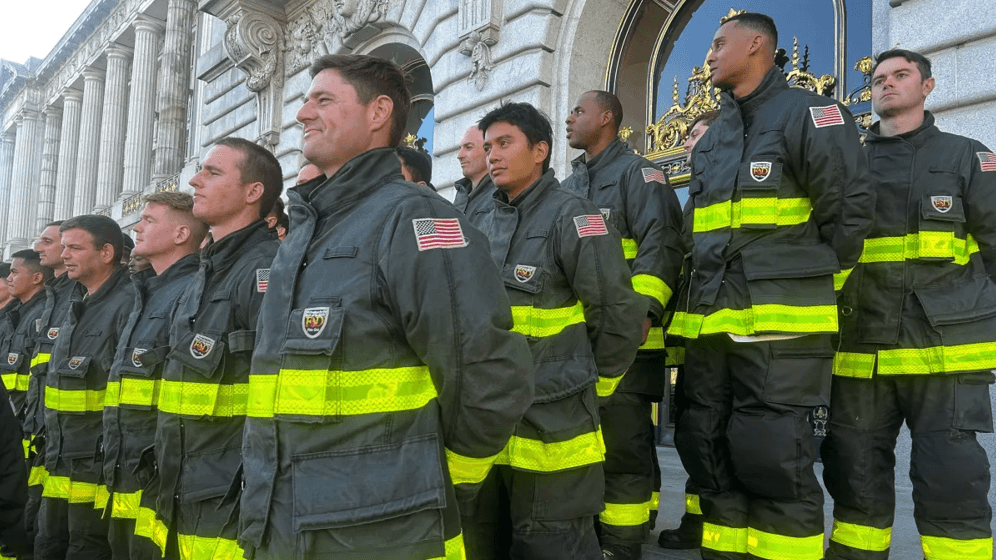
San Francisco firefighters debut their new PFAS-free turnout gear at a December 2025 press conference – a milestone achievement that SFFCPF helped drive by advocating to remove “forever chemicals” from protective equipment.
On a spring evening this March, beneath the chandeliers of San Francisco’s historic Palace Hotel, hundreds will gather to celebrate a milestone: the 20th anniversary of the San Francisco Firefighters Cancer Prevention Foundation (SFFCPF). Founded in 2006 by retired fire captain Tony Stefani after his own battle with a rare cancer, the SFFCPF was the first organization of its kind in the United States dedicated solely to preventing firefighter cancer. In the two decades since its humble launch, this once small volunteer-led effort has grown into a national beacon – pioneering research, changing policies, and, most importantly, saving lives in the fire service.
A Mission Born from the Firehouse
The SFFCPF’s origin is a story of turning personal adversity into community action. In the mid-2000s, Captain Stefani noticed an alarming “epidemic” of cancer among his fellow firefighters. After yet another funeral for a colleague lost to cancer, he approached the local firefighters’ union with an idea to address the crisis. With support from union members, Station 1 firefighters, and UCSF oncologist Dr. Marshall Stoller, the foundation was formed with a bold goal: prevention, education, and early detection of cancer in the fire service.
“The things we were trying to accomplish had never been done before in the fire service,” recalls SFFD Deputy Chief of Administration Tom O’Connor, one of the founding board members. The SFFCPF started as a “little foundation” led by Stefani, but it quickly gained momentum. By 2013, it was featured in the HBO documentary Toxic Hot Seat, which brought international attention to firefighter cancer risks.
“From that moment forward, it was full speed ahead … The ‘little’ foundation started by Tony Stefani has become a giant,” O’Connor reflects, noting that today SFFCPF is “the national leader addressing cancer in the fire service.”
Crucially, the foundation has always been sustained by people on the front lines. An unpaid, all‑volunteer board of active and retired firefighters (along with supportive civilians) guides its work. From Day One, SFFCPF built partnerships – with the San Francisco Fire Department (SFFD), Local 798, top universities, medical centers, and government agencies – to bring the best science and resources to bear on this issue.
Operating independently as a 501(c)(3) nonprofit with no city funding, the foundation’s sole allegiance is to firefighter health. What began as a small group determined to “do something about” a growing tragedy has evolved into a powerhouse of cancer prevention.
Pioneering Research and Early Detection
From its inception, SFFCPF recognized that understanding the problem was the first step to solving it. Firefighters, regularly exposed to smoke and toxic substances, were long suspected to face higher cancer rates – and the foundation set out to prove it. In 2007, partnering with UCSF’s Department of Urology, SFFCPF conducted its first targeted cancer screenings.
A peer‑reviewed study revealed significantly higher rates of genitourinary cancers among firefighters, including multiple cases of an otherwise rare bladder cancer (transitional cell carcinoma). This early finding established a direct correlation between firefighting and elevated cancer risk, validating firefighters’ concerns with hard data.
Over the next two decades, the foundation spearheaded an unprecedented series of scientific studies and screening programs. In 2010, SFFCPF collaborated with the National Institute for Occupational Safety and Health (NIOSH) on a cohort study of 30,000 firefighters from San Francisco, Chicago, and Philadelphia, which confirmed higher cancer incidence and mortality rates in firefighters compared to the general population.
In 2012, alarmed by a cluster of breast cancer cases among the city’s female firefighters, SFFCPF helped launch the Women Firefighter Biomonitoring Collaborative with UC Berkeley, the first research project to investigate chemical exposures in women firefighters. That same year, Stefani testified before the U.S. Senate about firefighters’ heavy exposures to flame retardants and other toxins, bringing the issue to the national policy arena.
San Francisco Fire Department Ladder 13 hoists an American flag outside the Palace Hotel, welcoming guests to an Igniting Hope Gala – the foundation’s signature event supporting firefighter cancer prevention.
Many “firsts” followed. SFFCPF funded a pioneering study measuring flame‑retardant chemicals in firefighters’ blood in 2013, which found alarmingly high levels and helped push California to curb toxic flame retardants. The foundation organized regular screening clinics – for cancers of the bladder, colon, skin, and more – offered at little or no cost to active and retired firefighters. These efforts directly saved lives by catching cancers early.
Foundation‑sponsored screenings have detected cancers at early stages that might have otherwise gone unnoticed. One major initiative in 2022 provided 1,786 members with an advanced multi‑cancer blood test, identifying 11 firefighters with early cancer signals who could then get timely treatment. Such programs underscore SFFCPF’s philosophy that early detection is critical in a profession where aggressive cancers often strike at young ages.
The impact of this work is tangible. Over 20 years, SFFCPF has supported hundreds of firefighters and family members through cancer diagnoses and treatment. It has funded more than a dozen major studies in partnership with UCSF, Stanford, Harvard and others, greatly expanding scientific understanding of firefighter health risks.
The foundation’s findings have driven changes in how firefighters do their job. After studies showed dangerous contamination on gear and equipment, the SFFD issued new policies – from a stricter “overhaul” procedure in 2016 to rigorous fireground decontamination rules in 2019 – to reduce crews’ toxin exposure. When data revealed unusually high cancer rates in women firefighters, the department invested in better‑fitting protective gear and facilities for female members.
In 2015, scientific evidence gathered by SFFCPF helped prompt Mayor Ed Lee to sign California’s Firefighters Cancer Presumption Act, strengthening line‑of‑duty cancer protections. The foundation notes that its efforts have informed multiple SFFD policy updates, “informed national, state, and local legislation,” and spurred new state research funding to combat firefighter cancer.
Leading the Charge for PFAS‑Free Gear
One of SFFCPF’s most game‑changing initiatives has been the fight to eliminate PFAS – the “forever chemicals” linked to cancer – from firefighters’ protective gear. For decades, firefighters wore turnout coats and pants imbued with PFAS chemicals in moisture barriers and coatings. The very gear that shielded firefighters from flames was quietly harming them.
The foundation had long raised alarms about these “legacy” turnouts, grimly nicknamed “cancer suits.” Backed by years of advocacy and evidence, San Francisco took bold action. In 2024, the City became the first in the nation to ban the use of PFAS in firefighter clothing, with a mid‑2026 deadline for SFFD to transition entirely to PFAS‑free ensembles. The foundation played a crucial role in this effort, rallying firefighters and working with city leaders to prioritize firefighter health.
The results of that advocacy are now on full display. By December 2025 – well ahead of schedule – San Francisco firefighters had fully switched over to new‑generation turnout gear free of PFAS. With help from a FEMA grant and City funds, SFFD procured 1,100 sets of PFAS‑free gear, enough to outfit every frontline firefighter. This makes SFFD the largest fire department in the United States to adopt non‑PFAS gear, setting a precedent for others to follow.
“This step places San Francisco at the forefront of firefighter safety,” Mayor Daniel Lurie declared at a 2025 press briefing.
Fire Chief Dean Crispen credited a “strong, coordinated effort” among the fire department, City Hall, the firefighters’ union, and the SF Firefighters Cancer Prevention Foundation for making the transition possible. In short, SFFCPF helped prove that if safer gear exists, firefighters and their families deserve nothing less.