Is it even possible to get a Canadian and an American in the same meeting for more than an hour without the terms “tariff” and “51st state” coming up?
It is.
At least it is when the topic eclipses trade relations and annexations. When the shared mission is so big, cooperation isn’t just nice, it’s necessary.
Helping the families of fallen firefighters and preventing line-of-duty deaths and injuries is just such a mission. And on each side of the U.S.-Canadian border sits two organizations doing just that.
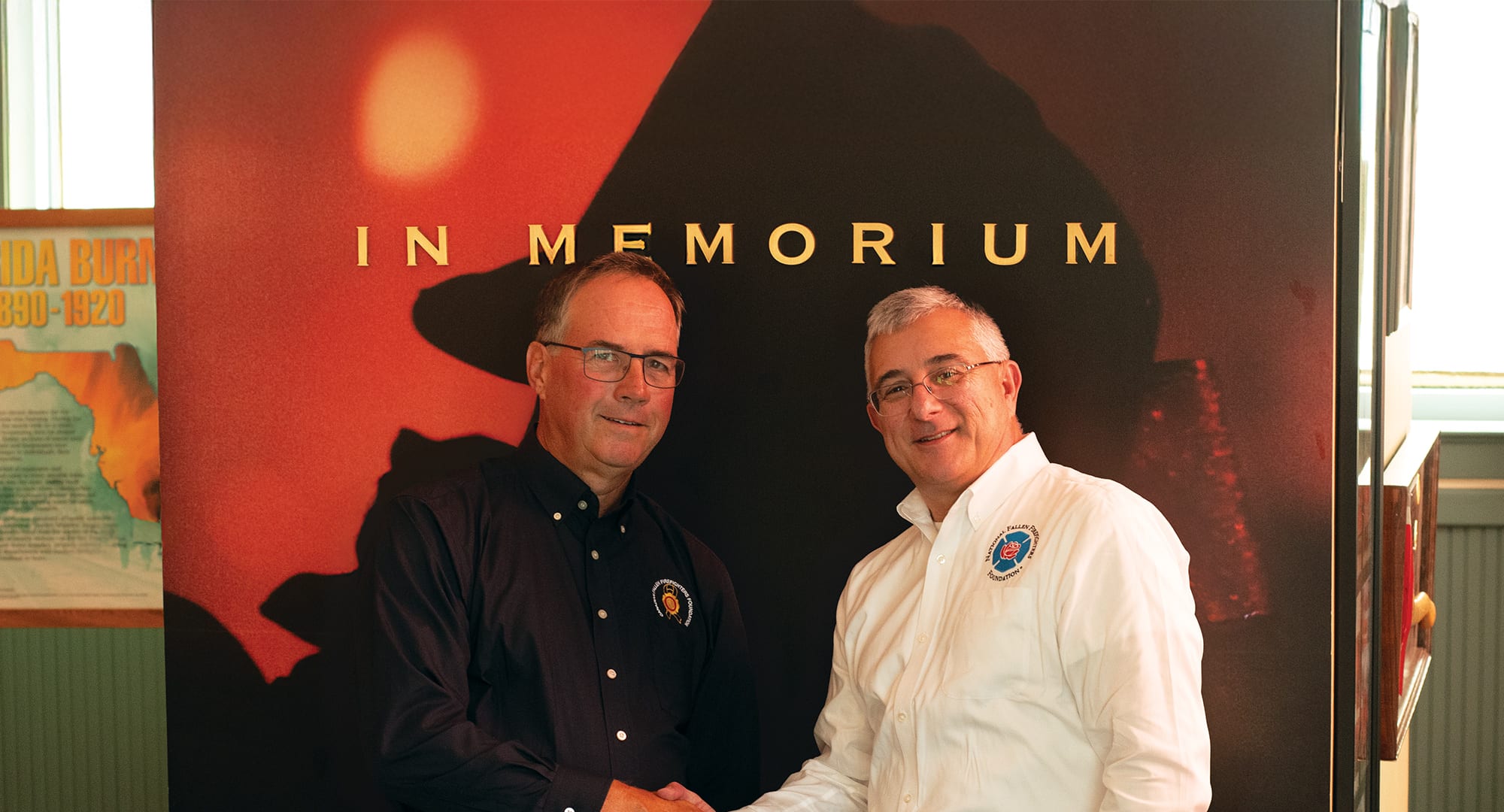
Leading the Canadian Fallen Firefighters Foundation is David Sheen. He’s been with the CFFF for about 22 years. Sheen started out as a Toronto firefighter, moved up to become the department’s public information officer and eventually a division chief. He later became the emergency management coordinator for Ajax, Ontario. He was invited to join the CFFF board when the group first began. He became its secretary and has been serving as president for the past seven years.
Victor Stagnaro started volunteering as the National Fallen Firefighters Foundation’s incident commander for the memorial weekend in the late 1990s. He assisted the NFFF in New York after the 9/11 attacks. Then he stepped back from the NFFF until about 2010 when then-director Ron Siarnicki asked him to become an employee and head up the NFFF’s line-of-duty deaths prevention programs. He stepped up to managing director and eventually was hired as CEO in 2023 when Siarnicki retired.
Like Sheen, Stagnaro came up through the fire ranks, spending 25 years at Prince George’s County Fire Department in Maryland. And like Sheen, Stagnaro also served as his department’s public information officer.
To be sure, the two organizations and their leaders have a lot in common. Their missions and much of their approach to achieving that mission align. And the groups certainly have their differences. Yet beyond their age, staffing, and funding differences, one thing was startling when I asked both men what surprised them most about leading their respective groups.
Both spoke about the unfathomable resilience of the families, the LODD survivors. Then, they diverged.
“It’s being around some of the best people on the planet, the people who are really focused on trying to prevent line-of-duty deaths and injuries, their commitment,” Stagnaro said. “I can call any fire department in the country and the answer is going to be ‘yes’ before they even know what the question is. We take that as stewardship. We need to be very cautious about how we utilize that level of power and influence.”
And for Sheen? “My biggest surprise probably has been the lack of awareness or participation from a lot of firefighters for, even both foundations,” Sheen said. “I don't want to speak for Victor, but I know certainly, each year we get new surprises of firefighter organizations or groups that aren’t even aware that we exist.”
Again, the common mission and shared struggles make working across the border a no-brainer.
“They say that imitation is the most sincere form of flattery,” Sheen said. “We're going down that exact same path. So, why not learn from one another? We have an ambassador from the NFFF to the CFFF and an ambassador from the CFFF to the NFFF. So there is a really close tie between the two organizations.”
So beyond attending one another’s events and meeting up at conferences, what does this cooperation actually look like? The boots on the ground stuff?
“NFFF does a fantastic job, as Victor’s already alluded to, of harnessing volunteers to make all of their memorial weekend a reality,” Sheen said. “And for us, we finally got there last year where after a few years of talking to Victor’s people, their volunteers, getting those behind-the-scenes looks. They helped draw that blueprint for how to better harness the volunteer component into our weekend.”
And for those who’ve never attended a memorial weekend in either country, they are overflowing with grief, pain, remembering, healing, and more pain. They are both emotionally vital and rough. Sheen and Stagnaro do this year after year, not just for one line-of-duty death, but for all of them.
From the outside, that looks like a heavy lift.
“For me, it's very rewarding. I don't feel it as a burden,” Stagnaro said. “I'm moved by the families and the work that we do. The valuable comments we get is a reminder of how impactful it is that I get to lead an organization that’s responsible to honor every fallen firefighter and support their families. So, to me, it’s a privilege to be able to do it.”
Stagnaro cited a recent conversation he had with the family of a fallen firefighter whose son didn’t want to attend the kids camp, but went anyway. The son had been struggling with the loss. The mother told him her son came home from camp with a bounce in his step and started playing with his friends again.
“She looked me in the eyes and said, ‘I got my son back.’”
Sheen, likewise, channels that pain into purpose.
“It's interesting. Obviously everybody handles their emotional load differently, and it can be a challenge,” Sheen said. “When you see the difference that the work you’re doing in honoring fallen firefighters makes to the families, that in itself, is such a reward that it lifts that emotional burden off of you because you know that your work is vitally important and so worthwhile.”
Both said they lean heavily on their wives and families for support. It keeps them grounded, they each said. And for Sheen, that gives him the courage and freedom to fully express what he’s feeling in the moment.
“I wear my emotions on my sleeve,” Sheen said. “When I speak at the memorial ceremony every year, I always get choked up; it affects me that deeply — seeing the families and seeing their grief and their dealing with it. But my wife grounds me incredibly and always reminds me of an interview that Gen. Norman Schwarzkopf did with, I think it was Barbara Walters, where he started to cry and Barbara Walters asked if he would be embarrassed that his troops would see him crying on TV. He said, ‘I don't trust a man who can’t cry.’”
And remember, both men came up through the fire service; neither was blindly thrown into the grief cauldron unprepared. In fact, in both their capacities as public information officers, each had a hand in organizing memorial services and events for their departments.
Where we are and how we got here is only part of the story. Where we are going is equally, if not more, important. And Stagnaro and Sheen have visions for what they hope their groups will look like in the coming decade.
In addition to growing their existing programs, Stagnaro sees the NFFF moving into new areas.
“I’d love to see more research on grief,” Stagnaro said. “That would educate us as to how we better support our families, but it also has a ripple effect across the world — how to better support people that are grieving.
“We as a country don’t manage grief very well; we don’t handle death very well. There’s a lot to be learned there.
“My vision would be that we’re the ones offering grants to reduce line-of-duty deaths. That would be my ideal world in the next 10 years.”
“I look at both foundations on parallel paths,” Sheen said. “NFFF had a 10-year head start on us. So, I find through the relationship with Victor, with his board of directors, that what we’re experiencing at this stage in our existence is what they were experiencing 10 years ago. That’s why it’s so important to us to be able to get some insights, because it helps you steer your way through those things. So, 10 years from now, I hope I see the CFFF where I feel the NFFF is right now.”
Meaningful collaboration across both organizations will be even more important over the coming decade in large part because of the elephant in the room. That elephant is of course the F-word. No, not that F-word, rather, “funding.”
“Yeah, down the line there’s a real opportunity for us to combine forces,” Stagnaro said. “How can both organizations be supporting the funding to do the research that’s needed to be able to expand our programs appropriately so that we’ve got the best data to do the work to help support the families and have fewer deaths?”
Future funding is part of the mix. Funding existing programs in the here and now is a problem keeping both men up at night.
Stagnaro said funding reductions are coming at a time when the NFFF is opening its program to more families to include firefighters who died from causes beyond line-of-duty incidents, such as cancer or suicide.
“I’m very concerned about our opportunities and our ability to not continue the services we have but to be able to expand the work,” he said. “I mean, we should be doing research on grief and funding research and programs that reduce line-of-duty deaths. But, today we’re just trying to hang onto what we need to do for the next few months.”
“I echo what Victor’s saying, absolutely,” Sheen said. “Being an organization that has no funding except for fundraising that we do makes it difficult. The work we can do is only limited by the resources we have. And there’s so much more that I would love to be able to do as an organization.
“Right now, because there is not the flow of money that we really need to do everything, we just have to prioritize. So on the front end, obviously, what’s most important is our memorial ceremony each year. But, when we talk about our memorial weekends, they’re an expensive proposition. It takes a lot of resources to pull it off, not just in manpower.”
Similar to the idea of not putting all your eggs in one basket, the thinking for the CFFF and NFFF is to not collect all of your eggs from the same nest. They need diverse funding streams. And here again, the NFFF is further along that path.
Like other large non-profits, that looks like a mix of private donations, corporate sponsors, fundraising events, endowment money and federal funding. Which, of course, is a full-time job unto itself. One example is the CFFF’s partnership with Tumbleweed Distilling, where a portion of the company’s Unforgettable whiskey sales are donated to the CFFF to help pay for the memorial weekend.
Several Major League Baseball teams have a firefighters' appreciation day, where they donate a portion of each ticket sold to the NFFF. The New York Yankees and the Seattle Mariners are giving $5 per ticket.
“It’s a big challenge,” Stagnaro said of fundraising. “In the climate we’re in right now with the topsy-turvy economy, people are reluctant to let go of their money, whether it’s companies or individuals. They don’t know what’s going to happen in the next several months or years. So the challenges are greater right now than maybe they’ve ever been.”
“It filters right down through every aspect of fundraising and it presents probably our greatest challenge,” Sheen said. “The nature of it is such that you have something, but you can’t just rest on it. We have to find other sources in case this source changes.”
And like much of the fire service, the CFFF and NFFF have a lot in common. Common mission, common obstacles and hope for common solutions.
Leading the Charge
Fire Chief Les Karpluk and retired Fire Chief Arjuna George are proud to announce the launch of Leading the Charge: A Firefighter’s Approach to Resilient Leadership – a timely book focused on building stronger, healthier leaders in the fire service.
What sets this project apart? 100% of proceeds go to the CFFF, directly supporting the families of fallen firefighters.
Leading the Charge: A Firefighter’s Approach to Resilient Leadership
30 Fires You Must Know
A powerful look at major fires that shaped modern tactics and continue to teach us today.
All royalties are being donated to four vital fire service organizations: The Chief Ray Downey Scholarship, The Firefighter Cancer Support Network, The Tunnels to Towers Foundation, and The First Responder Center of Excellence.
30 Fires You Must Know: A Collection of 30 Historically Significant Modern Fires