
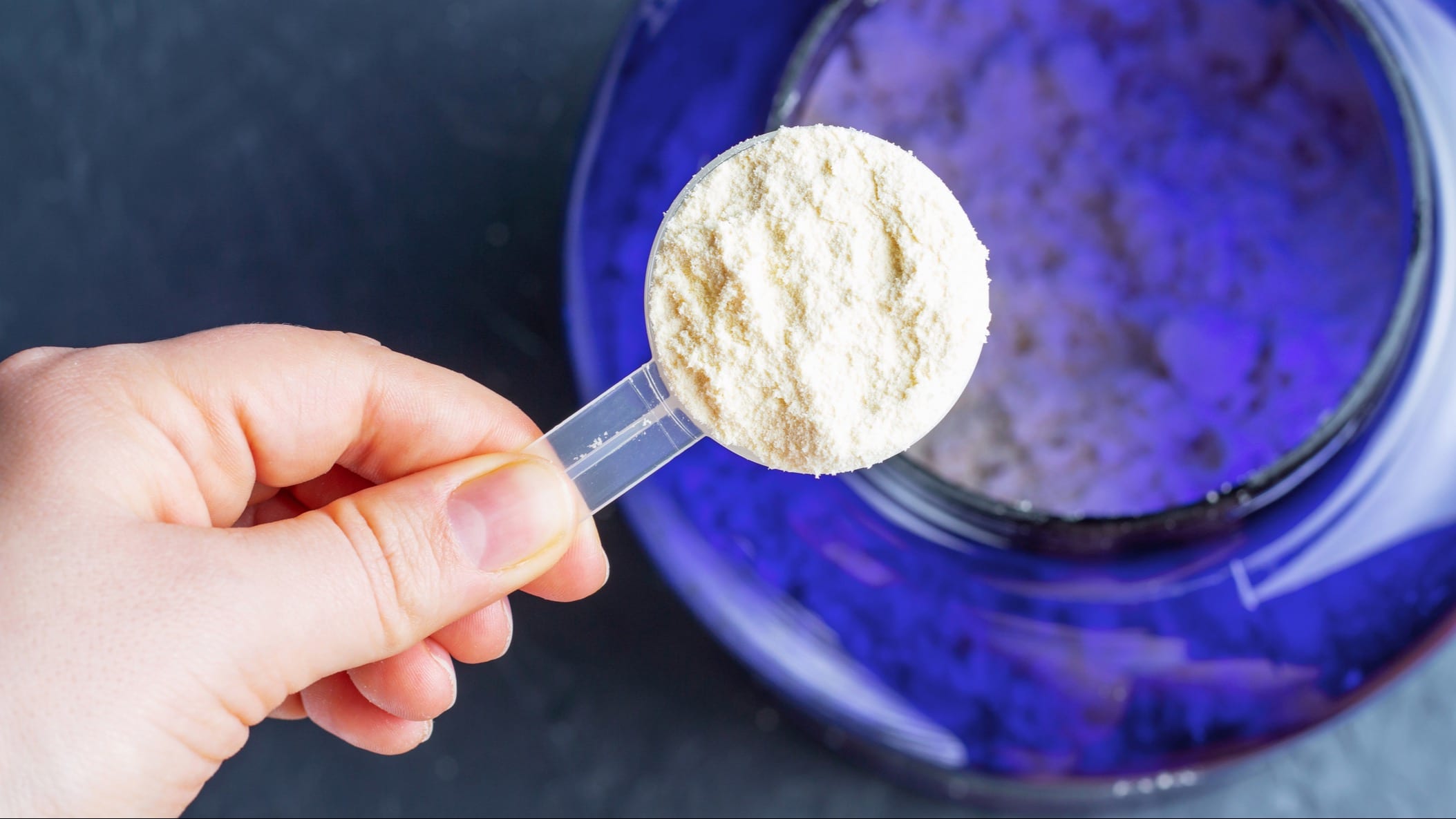
If you have been searching for that “competitive edge,” you may have considered several nutritional strategies to support your exercise training, physical performance, and overall health, and you likely have heard of creatine. Creatine is a naturally occurring amino acid found in whole foods. It is one of the most popular supplements. The research on creatine monohydrate (CrM) is compelling, with attention on enhancing exercise performance and training adaptions.
How to Supplement with Creatine
One of the most asked questions when using creatine is, “How much do I take and for how long?” There are two main ways in which you can begin supplementing with creatine:
- You can start with a loading phase, during which you take 20 grams per day for approximately one week, and then you can take 3 to 5 grams per day thereafter (maintenance phase).
- You can take 3 to 5 grams per day from the get-go.
If you start with a 20-gram per day dose for one week, you will want to break up the 20 grams into smaller doses throughout the day. This is so you minimize potential gastrointestinal distress-related issues, as there are anecdotal cases and some reported side effects. It is best to take 5-gram doses four times per day during the loading phases – these can be taken at breakfast, lunch or dinner, or pre-workout, during your workout, or post-workout, or even at a randomly spaced-out time of the day that best suits your preference. Once you have completed this loading phase, you can begin the “maintenance phase,” wherein you can take 3 to 5 grams per day for as long as you like.
Now, you may wonder, “What if I miss a day?” or “What if I want only to take creatine for five weeks and then restart supplementation later on?” or “What if I am traveling and that may disrupt my ability to supplement daily?” Here is one of the unique aspects of creatine supplementation: it generally takes about four weeks to “wash out” or return to your pre-creatine use baseline levels, meaning you can miss a day, two, or even a few days of supplementation without fully losing out on the benefits (in other words, you will not lose out on your “gains.”) This also means you have flexibility if you are traveling and cannot supplement regularly. If worse comes to worst and you completely stop taking creatine for four weeks or more, you can easily restart supplementation again.
Pragmatically speaking, as a first responder with a hectic work and life schedule, you can benefit from a nutrient that you can cycle on and off while reaping its benefits with a fairly simple dosage protocol. You may now wonder how creatine provides you with performance and health benefits. Let’s dive into the science.
What is Creatine ACTUALLY Doing in the Body?
About 95% of creatine is found in skeletal muscle, with the other 5% found in different body tissues, such as the brain. Two-thirds of the skeletal muscle creatine (aka, intramuscular creatine) is in the form of phosphocreatine (free creatine + inorganic phosphate). This is important to note because the phosphocreatine molecule is a powerful energy-producing molecule supporting adenosine triphosphate (ATP) regeneration (the fundamental unit of energy that drives human movement).
When we start to move or resistance train/lift heavy weights, we need ATP to support that movement/exercise. We have “bioenergetic systems” that help regenerate the ATP we need to move. This is where creatine plays an important role, as it can be used to regenerate ATP quickly. We have ATP stores in the body that support movement, but these stores deplete rapidly, and we are left with an intermediate molecule called adenosine diphosphate (ADP). Phosphocreatine can be broken down to free creatine and a phosphate molecule. This phosphate molecule can then regenerate ATP (ATP = ADP + the phosphate molecule). This fast reaction occurs to support activities, such as lifting heavy weights/objects, sprinting, climbing stairs, etc.
So, put simply, creatine supports our ability to move and exercise by rapidly restoring the energy stores we have in our body. Now, let’s take a bird’s eye view of creatine’s benefits related to exercise and performance outcomes.
Creatine’s Ergogenic Benefits
There are many favorable outcomes related to creatine and exercise performance. One of the leading creatine researchers, Rick Kreider, demonstrated that 15.75 grams per day for four weeks of CrM supplementation among 25 NCAA Division I football athletes led to increased lifting volume for the bench press, back squat, and power clean (+1,558 kg) and lean mass (+2.42 kg).
Bennett and colleagues also showed that 20 g/d for six days and 6 g/d thereafter for four weeks led to an increase in pull-up performance without negative health outcomes.
Nelson and colleagues and Graef and colleagues both showed that CrM supplementation can improve one’s ventilatory anaerobic threshold (this is the point that marks a level of exercise intensity where oxygen delivery to the muscle becomes a limiting factor and one must rely on anaerobic energy system support to exercise) by 12% to 16%.
These outcomes showcase that creatine can help support one’s resistance training outcomes and may allow one to train heavier or “harder,” which can translate to increased strength and lean mass gains over time.
Now, you might be thinking, “That is cool … creatine can improve training outcomes, but is there a study showing performance improvements in firefighters?” Yes, one study to date has shown positive outcomes related to firefighter performance.
Dr. Andrew Jagim’s research team out of Wisconsin completed a study showing that creatine, coupled with a protein and carbohydrate mixture, can enhance one’s ability to perform firefighting tasks. Specifically, 28 firefighters were assigned to ingest either whey protein isolate (25 g/d) with a carbohydrate (25 g/d) powder (ProCarb) or the ProCarb supplement with CrM (5 g/d) for three weeks.
Before and after the intervention, the firefighters completed a battery of occupational tasks, including a hose carry, victim dummy drag, stair climb, and forcible entry for time while wearing their full personal protective equipment.
The results showed the ProCarb and CrM supplementation group had faster times completing the victim dummy drag (1.78 ± 0.57 s) and forcible entry tasks (2.66 ± 0.97 s) – indicating a performance benefit for those taking CrM in addition to the protein and carbohydrate mixture.
Recently, sports science and nutrition researchers have highlighted the importance of creatine (specifically CrM) for firefighters and comprehensively discussed how CrM can benefit them in terms of body composition, mental and emotional health, brain health, cognition, thermoregulation, physical and occupational performance, and their sleep. This paper is open access and can be viewed online.
As always, we want to ensure that the reader is aware that creatine use is safe and effective. The U.S. FDA has classified creatine as generally recognized as safe (GRAS), and its safety profile has been well-studied and is recommended for all individuals across the lifespan.
Stay tuned for the next article on creatine and its benefits for firefighter performance and health.