What would happen if you invited high-profile leaders of competing corporations to sit down for an on-the-record conversation about their businesses?
Would each sit cross-armed, eyes darting suspiciously and grunt out one-word answers so as not to let slip any company secrets?
Or would they verbally sharp-elbow each other for the spotlight, letting the whole thing spiral into monologues about how great their company is?
Would it devolve into an all-out food fight with insults and barbs chucked across the table like handfuls of mashed potatoes and meatballs?
Or perhaps they would support each other and open up about their own deepest fears, hopes for the future, and failings. Would they express admiration for what the others are doing?
That last option? Yeah right.
But that was exactly what happened when we invited the top editors from the biggest fire service publications to talk about the what, how and why of their work. We wanted to give firefighters a good long look behind the curtain into the fire service publishing world. And those leading editors obliged — with nary a mashed potato or meatball chucked.
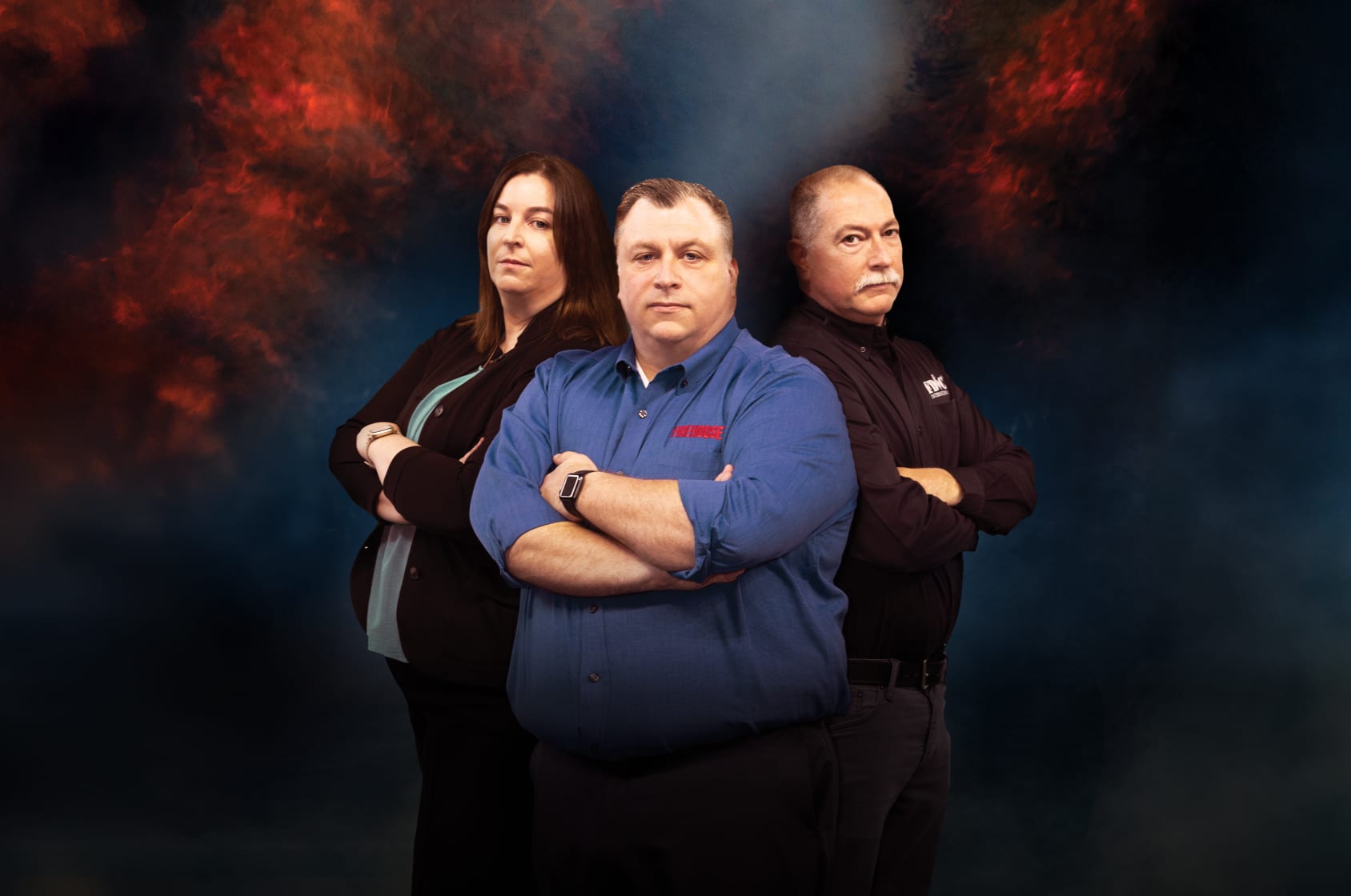
And while these may be familiar faces and names, let’s meet the crew properly.
Janelle Foskett
Janelle Foskett is editor-in-chief of FireRescue1. You may also remember her from her stints on the editorial staff of Fire Rescue and later Firehouse. In all, she has 20 years’ experience in fire service publishing and holds a bachelor’s degree in journalism.
Peter Matthews
Peter Matthews is editor-in-chief and conference director for Firehouse. He began his career as a fire service photographer before joining the publication in 1999. He’s been a member of three fire departments, rising to the rank of lieutenant.
David Rhodes
David Rhodes is editor-in-chief of Fire Engineering. He’s a retired fire chief and fire instructor who has served as an advisory board member for Fire Department Instructors Conference, U.L.’s Firefighter Safety Research Institute and the Georgia Fire Academy. This is his first editing gig.
As often happens in life, we sometimes find that perfect partner by accident. That’s pretty much how these editors found themselves running top fire service publications.
PETER MATTHEWS: I wanted to be a firefighter. I wanted to be on FDNY. I photographed a house fire and had that photo published, and I was like, wow, this is pretty cool. Jeff Barrington was Firehouse's associate publisher and served in the same fire department with me. I asked if he had any job openings. He said send us a resume. A year later they called back and I got a start — at the very bottom. I was very lucky.
JANELLE FOSKETT: I want to echo something Pete said about the luck involved. I feel so lucky to have landed in fire service media, coming from the journalism side. I applied for a job as an assistant editor at Elsevier Public Safety. I didn't even know at the time which vertical it was going to be for and it ended up being "Fire Rescue" magazine. It changed my life forever. And here I am 20 years later.
DAVID RHODES: I had never had plans to be an editor. I came up in the fire service as a firefighter, and did that for 36 years with three different departments. Bobby Halton started talking about my becoming his deputy editor to take some of the load off of him since he had FDIC and the magazine and several of the other brands. I was kind of like, “I don't know.” But he kept on at me. He says, “Look, I'm going to retire. And we're going put you on a three-year plan. I'm going teach you the business and it'll be a three-year transition.” And three months later he died.
Like Chief Rhodes, Matthews and Foskett learned from and followed the previous generation’s editorial giants, titans, if you will. They were a great presence and great teachers, but they also left a great void to fill.
MATTHEWS: I worked 14 years with Harvey Eisner before he died 10 years ago. It’s tough to fill those shoes. A lot of what Harvey and Bobby did started people on their career paths, and not only as career firefighters, but also wanting to give back through events, through the media and stuff like that. Which is great. I think that's the legacy that they're both leaving behind. You'll never fill those shoes. It's a loss that I'll feel for the rest of my career, because you still hear about them day in and day out.
FOSKETT: Learning from Chief Tim Sendelbach was just an unbelievable opportunity. Tim always talked about being a humble public servant. Tim instilled in me his insane work ethic and high standards. Sometimes that can almost be hard to live up to. I still talk to him. He’s a friend; he was at my wedding.
One of the things that was just great about being connected with Janet Wilmoth and having her as a friend and confidante was that it showed me you don't have to be a firefighter
to make a huge impact in the fire service. I struggled with that for a little bit. I don’t anymore. I’m confident, and she helped establish that.
RHODES: To that point, Bill Manning had no fire service interests and he was a huge advocate. The important thing is everybody has something to offer — but don't pretend to be what you're not. I would never even attempt to fill Bobby’s shoes. But I absolutely stand on his shoulders.
We then shifted the conversation to the role these editors see fire service publications playing in the modern media landscape. When industry giants like Harvey, Janet and Bobby were coming up, editors were information gatekeepers. They decided what was worth publishing and what was crap. For better or worse, the long reach of social media has stripped editors of that traditional gatekeeper role.
MATTHEWS: One thing that is very exciting is that young people are getting a voice. It’s a little scary, but it’s cool. A person puts out something; they may not be a firefighter, but people are going to them as a trusted source. As a media company, we had to wrap our heads around that and move forward. We’re making sure the information we put out is valid and the folks we are working with are legitimate.
RHODES: Yeah.
FOSKETT: I want to add to that. I don’t know how this bodes for the future, but people are hungry to communicate. For a long time, people felt like you had to know someone on the editorial staff or be a certain kind of chief officer to get published. I’ve always said there is no secret handshake. There are a lot more people who realize they can speak up. And we can help them do that.
RHODES: Like the changes to the music industry. It’s like in the past you had to play the game and be in the right circles.
MATTHEWS: Yeah.
RHODES: You have to be careful of where you're getting your information because of the vetting issue. There's a lot of really good stuff out there by individuals. But there's also some stuff that's either false or is very narrow-agenda driven.
FOSKETT: Having an outlet, like our three, where people can turn means they know the content is from people who know what they're talking about. People seek out legitimate voices still, especially in the crowded, cluttered world of social media. People can still come back , and we're home.
Each of our three editors devotes time to understanding and explaining what it takes to be successful in the fire service. That can be a deep dive into what different ranks and roles do on a daily basis. Partly thanks to them, those of us in small departments get a feel for busy houses; we understand what it takes to get into the weeds of specialties that we aspire to learn. But what does their world look like, I mean, really look like? What would surprise firefighters about the editing life?
FOSKETT: We’re a small but mighty team. We have our hands in everything. A lot of people might think we’re more like consumer media where there's a person assigned to each task — this person handles podcasts, this person handles print, etc. But really a lot of us just have our hands in a little bit of everything.
MATTHEWS: That's a great point. Because you do want to make sure everything is going out and it's meeting that bar we've set. Honestly, that is just the dedication of our group here. We all care. It's really a dedication to improve, educate and give the fire service everything they need to make educated decisions, whether it's purchasing, fireground operations or even just navigating the challenging fire service today.
RHODES: There’s the sheer volume of work and emails and all the non-glamorous stuff. Everybody reads the editorial, they see the little video and they see FDIC, and think, man that must be great – you get to do this you get to do that. And it absolutely is great. But for everything that you actually see, there are hours and hours and hours of work and collaboration.
So, with all that work, all that travel, all that being constantly “on”, how do these editors balance work and life? Do they take the advice they’re always giving to firefighters?
Eyes were rolled. Heavy sighs were released. There were mutterings, uncomfortable chuckles and downward gazes. They each talked about trying to get outside, even briefly, about stopping work at a certain time, about turning off their devices, and about other little life hacks to preserve sanity.
In the end, each admitted to needing to do more in that area. This was followed up by pleadings and not-so-veiled threats about not publishing those remarks. Hmmm, maybe all that camaraderie among competitors was because they had a common enemy. Nah, couldn’t be.
In all seriousness, making the fire service a better, safer place has been their life’s work. As Matthews said, he takes it personally every time a firefighter dies or is injured in the line of duty. He said it feels as if he hasn’t done enough. The others nodded.
That level of dedication is why they work the hours they do, why the products they deliver to the fire service are high quality, and why they can open up here without one spoonful of mashed potatoes being flung.