

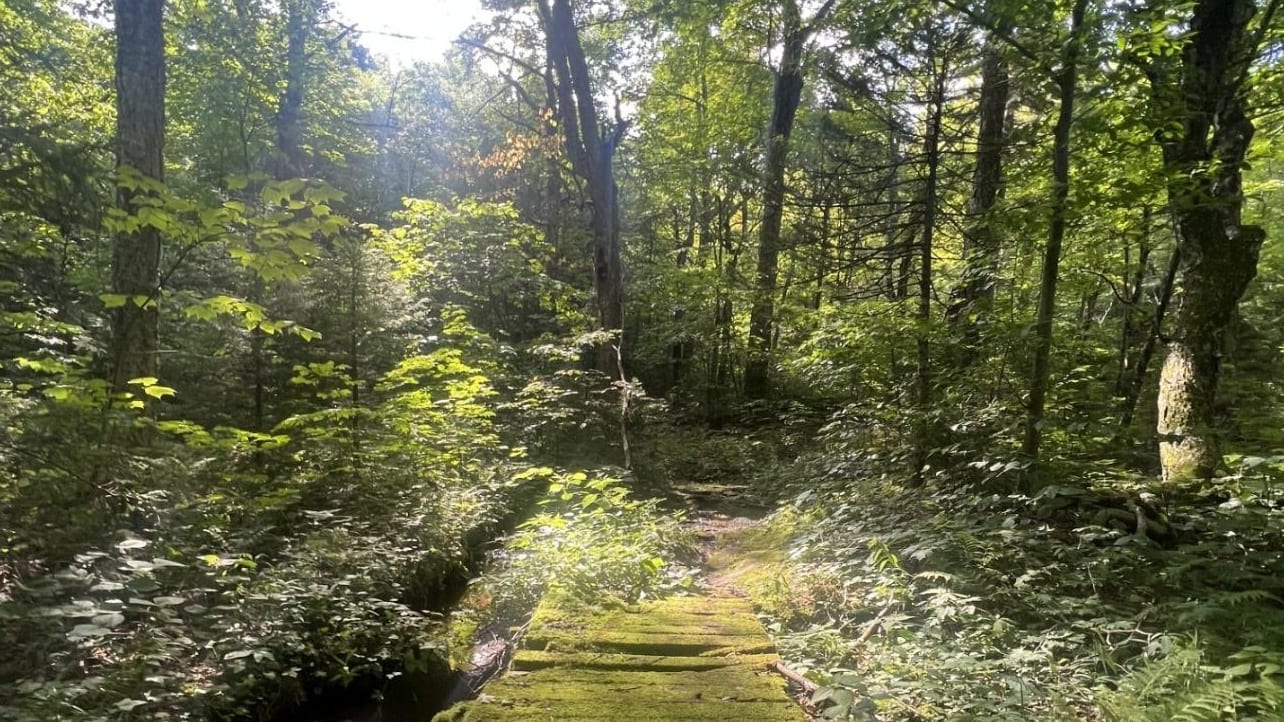
A moss-covered wooden walkway lines a trailed portion of Kaaterskill High Peak. Photos courtesy of Joseph Dunnigan
A hiker’s guide on how to start hiking
After writing A Hiker’s Guide to the Fire Service, I thought about when I actually returned to the sport of hiking. I thought about when I went from my semi-sedentary life back to the great outdoors. When I went from couch to summit.
The Gunks: There and Back Again
Growing up in the Hudson Valley, I have fond memories of hiking trails in the Shawangunk Mountains, also known as “The Gunks.” Their name is derived from the Lenape language, and according to the Lenape linguist Raymond Whritenour, means “in the smoky air.” It’s a fitting name, for my hiking memories began to dissipate when I left those mountains behind.
When I went to high school, I mostly gave hiking up and instead began to ride my ATV around the valley below those same mountains. After, I attended community college, not far from those foothills, I moved to New York City. It was then that all my outdoor adventures suddenly ceased. I seldom ventured back to the Hudson Valley nor stepped on those trails in smoky mountains. At least not for a while.
After not hiking for more than a decade, I decided to start up again. While I stayed in some type of shape after joining the fire department, I still felt a bit nervous about going back to the woods. I felt I was inexperienced in the world of hiking. I felt I needed practice.
The Misty Mountains of the Catskills
My first trail back was a short 3-mile one not far from my hometown. The place is called Dover Stone Church. It was named after the village it is in, combined with the trail’s main attraction, which is a cave that has cathedral-like features. The Dutchess Land Conservancy relates the legend of the “Stone Church” on its website as being the place where a Native American chief and others took refuge during the Pequot War. I remember it as being my return to hiking.
Dover Stone Church viewed from outside the “cathedral’s” entrance.
After Dover Stone Church, I hiked the Siwanoy Trail in the Bronx. I then traveled throughout the woods of the lower Hudson Valley. However, I needed more challenges. That’s when I decided to go back to The Gunks. Just one problem: I was still apprehensive to hike the mountains of my youth. So, I went online for help. After a few days of searching, I found a group on Meetup that happened to hike the Shawangunks. I decided to tag along.
On our hike, I noticed a few of the people had backpacks full of patches. I asked a hiker about one that was green and had the words, “Catskill Club 3500” on it. They told me it pertained to a hiking club and challenge. I found out it was something called peak-bagging, which consisted of completing a list of 37 hikes in the Catskill Mountains, all of which had summits over 3,500 feet in elevation. I smiled, knowing I had found my next test. Still, I was uncertain if I would be able to do more demanding routes on my own, some of which included peaks where hikers had to navigate the wilderness without trails in a form of hiking called bushwhacking. Luckily, the internet again provided a way.
After that hike in The Gunks, I checked out the Catskill 3500 Club’s website. There, I found out they provided guided hikes. I perused their schedule and signed up for the ones I felt were the most challenging to do alone.
To build up stamina, I trekked easier trails on my own. Peaks that were still over 4,000 feet tall, such as Slide Mountain, but were simpler to navigate because they had old carriage roads or paths leftover from the 19th century-era lumber industry. After I got a few mountains under my belt, I joined the club for the more difficult hikes. Eventually, I was doing two and even three peaks in one go. Then came the dreaded bushwhack.
I remember our guide used their compass, GPS, and a map to lead us over rock formations, between bare trees, and upon layers of slippery leaves. As part of a group, I was never worried. I had confidence in our guide’s ability. When it was my turn to go solo, I wasn’t so sure I’d get the same outcome.
Overcoming My Mount Doom
Kaaterskill High Peak was the trail I decided was to be my first solo whack. I chose it because it was considered semi-trailless.
The day I hiked it, I remember thinking that the mountain seemed, well, insurmountable. Still, I stepped off the trailhead and I began my hike. A hike that would turn out to be about 4 hours of trekking 7 miles.
During that 7-mile hike, I would walk through mud, over fallen logs, on moss-covered rocks. I would see paw prints left by what I hoped was a domesticated dog and not something else. I would feel the sweat roll down my back and the pain in my knees. I would contemplate turning around several times and several times I would push forward. When I reached the summit, I would see a simple orange canister nailed to a tree. It would be there that I would sign my name, leaving a token of my journey. That would be the easy part.
Paw prints on my way up Kaaterskill High Peak.
After reaching the top, I would of course have to begin my descent. A bushwhack descent that would bring me through thick evergreens whose branches were like walls made of sap and pine needles. Through cobwebs that appeared big enough to trap small birds and mammals. Through glacial erratics that reached out from the ground like stone tendrils hoping to make me misstep into one of their crevices. Again, I would hear the voice in my head telling me, “You’re going the wrong way.” I would pick up pace and try to outrun that voice, while those rock fingers, pesky cobwebs, and sap-covered branches all attempted to block my path. And just as my phone’s battery showed red as it began to give its final breath, I would see a field and after it the trailhead.
When I returned to my car, I would look up at that tree-lined mountain again, this time knowing that it was climbable.
Cobweb in the forest of Kaaterskill High Peak.
Tips from My Journey
Looking back at my hiking experiences, I realized that I had learned quite a few lessons. Below are a few thoughts I’d like to share for those who are about to begin or return to the sport of hiking:
- Start Easy – In the beginning, find trails that are short, don’t have much elevation gain, and are not too challenging.
- Build Stamina – Increase the difficulty level gradually. Hiking is an exercise. It can take a few hikes on various trail types to build stamina and skill.
- Hike with Others – Hiking alone is peaceful and meditative but going with others can make harder trails feel less challenging. If you have difficulty finding people to hike with, local hiking groups/clubs may be a good option. Many can be found by searching online.
- Hike with a Guide Before Attempting the More Challenging Routes – Guides are often excited to teach their knowledge and skills, such as using trail markers, maps, or GPS to navigate. Also, they may have tips on what gear you should have before your next trip.
- Remember Your Purpose for Hiking and to Have Fun – Trails and nature are places of adventure and therapy. When they become grueling expeditions that leave you wishing you hadn’t left your bed that day it may be time to reassess how they’re being treated.
Ramble On
It seems so long ago that I got back into hiking. Nowadays, I can say that I’m finally done sitting on the couch and enjoying summitting the summits once again. As for my Catskill 3500 Challenge, I have five out of the 37 hikes left, a few of which are bushwhacks that I look forward to completing. Now, I leave the rest to you. As J.R.R. Tolkien once penned, “Don’t adventures ever have an end? I suppose not. Someone else always has to carry on the story.”