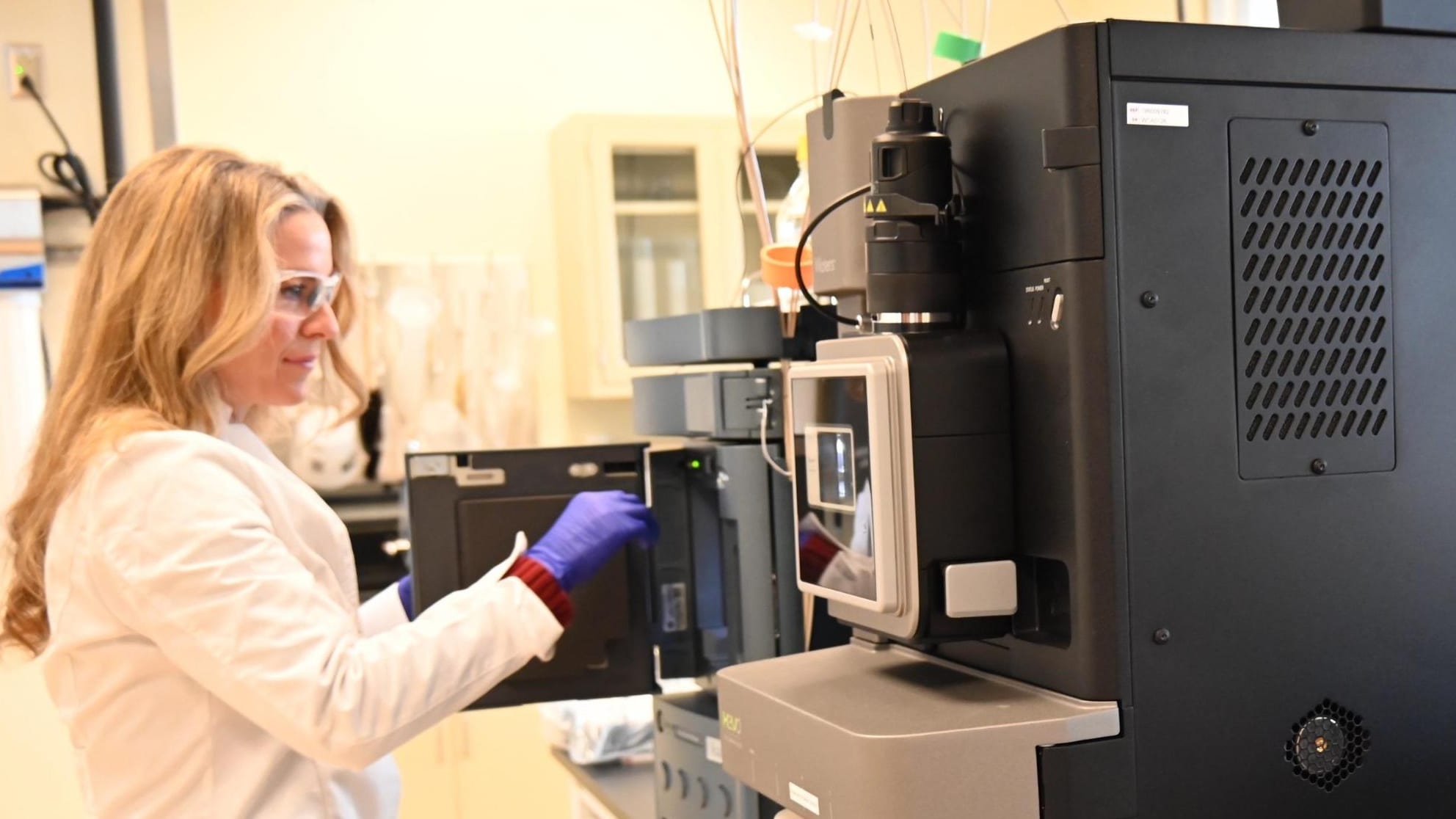
Dr. Crystal Sweeney prepares the LC-MS/MS for the analysis of PFAS in serum collected from firefighters for the IFSI Research Laboratory’s Illinois Firefighters Cancer Risk Study (IFCRS) (Spring 2025).
If you’ve ever been to our 28-acre fire training grounds here at the Illinois Fire Service Institute (IFSI), you might overhear our instructors call it their “playground” – a true indication of their love of what they call the “best job in the world.”
At the IFSI Research Laboratory, you will hear the same sentiment from our research scientists who devoted their craft to the cause, spending each day focusing their knowledge and expertise on the health and safety risks that plague the fire service.
Currently, the greatest threat to firefighters is a long list of occupational cancers and the toxic fireground exposures that contribute to them. IFSI Research has answered the call to help firefighters monitor and mitigate harmful exposures that find their way into the body as part of our mission to stay ahead of cancer. However, we can’t effectively mitigate what we can’t measure.
Building a state-of-the-art laboratory with sophisticated instruments capable of measuring nearly every known toxic fireground chemical on a parts-per-trillion scale in complex biofluids like blood, urine, and sweat is no simple mission. But that is exactly what Dr. Farzaneh Masoud decided she would do when she stepped into her role as IFSI’s Director of Research in 2019. As a cancer researcher, she knew that a highly skilled team of interdisciplinary scientists (her team grew from only three members to nine in less than four years!) operating a high-tech lab with a wide range of analytical capabilities devoted specifically to firefighter health and safety would be a non-negotiable step in getting ahead of the cancer epidemic in the fire service.
Laboratory benches installed and site preparation completed for LC-MS/MS installation (Spring 2024).
I met Dr. Masoud when I first visited IFSI in February 2024. The research laboratory was still in her vision stage, but her vision was so vivid that I could see it, too! When given the opportunity to join IFSI Research, it took me less than six weeks to rearrange my life in Canada, pack up as many of my belongings as I could (notably my husky, Adora), and move to Champaign, Ill., to become IFSI’s analytical toxicologist. A year later, Dr. Masoud’s vision became my reality. The incredible work that is happening here makes me jump out of bed every morning and keeps my mind swirling with ideas every night – and yet, very few firefighters know about the impactful research happening at IFSI on their watch, on their behalf.
This article provides a glimpse of the leading-edge equipment in the analytical arm of our firefighter health and safety research laboratory. We want to give you a greater sense of our heartfelt mission and extensive wingspan of testing capabilities for firefighters. Our lab is equipped with three mass spectrometry platforms: liquid chromatography-tandem mass spectrometry (LC-MS/MS); gas chromatography-tandem mass spectrometry (GC-MS/MS); and inductively-coupled plasma-tandem mass spectrometry (ICP-MS). Let’s break it down one at a time:
A conversation between researchers and firefighters: Dr. Crystal Sweeney talking through the science behind firefighter health — no jargon, just what matters — with Jonathan Frye (IFSI Assistant Director of Logistics and Resource Training Support) (Fall 2025).
We use the LC-MS/MS to measure toxic fireground substances (and their metabolites) in serum, urine, or sweat. We currently measure 30 different PFAS in serum and I’m in the process of developing a rapid method for 10 different PAH metabolites in urine, as well as a comprehensive hormone panel, important for both male and female firefighters in maintaining optimal health and performance both on and off duty.
Our GC-MS/MS is used for measuring volatile organic compounds (VOCs), which are usually quickly eliminated from the body in exhaled breath or as urinary metabolites. However, some can accumulate in the body, which is especially concerning for firefighters who are more frequently exposed to high levels of VOCs compared to the general population. We aim to regularly measure these chemicals (such as benzene, formaldehyde, and PAHs) in our firefighter biomonitoring program to learn what levels are being stored in the body, how those levels change over the course of your career, and what detoxification strategies work best.
As hot as our IFSI training grounds get during our live fire operations, the plasma inside our ICP-MS reaches the same temperature as the surface of the sun! It makes sense though, because this instrument is used to measure metals, and immensely high heat is required to mobilize and ionize metals in complex samples. Our ICP-MS allows us to routinely measure toxic metals such as arsenic, cadmium, chromium, lead, lithium, mercury, and nickel in firefighter blood samples.
Why does firefighter health and safety research require a devoted lab with such an elaborate set-up? Why not simply outsource to other labs that already have these analytical capabilities? Our team at IFSI Research have five reasons, each of which on their own is reason enough:
- Time: A third-party laboratory’s queue can be large, taking months or even years to obtain sample analysis results. For some of our methods, IFSI Research can analyze up to 60 samples per day within days of collection. Firefighters are battling cancer, cardiovascular disease, and other occupationally related ailments and time is of the essence.
- Money: Analytical services such as firefighter biomonitoring at third-party labs can be cost-prohibitive for fire departments, with costs reaching hundreds to a thousand dollars for a single sample, depending on the type of analysis. Our laboratory operates at no cost to our participating firefighters.
- Loss of sample ownership: Once a sample is shipped to a third-party laboratory, your leftover sample is usually claimed by the facility or discarded, eliminating potential opportunities for downstream or follow-up testing. IFSI Research keeps your sample securely stored onsite, allowing you to withdraw participation or your sample at any time, no questions asked.
- Lack of privacy and confidentiality: It is far more difficult to ensure the protection of firefighter privacy and confidentiality when third-party commercial laboratories are involved. IFSI Research participants are protected by multiple overlapping layers of data security.
- Lack of quality assurance/quality control (QA/QC) transparency: Third-party commercial laboratories often keep certain components of their methods confidential, making QA/QC protocols and other pertinent information inaccessible to researchers and limiting the reach to firefighters who are most impacted. The IFSI Research Team is comprised of highly qualified personnel who have dedicated their careers specifically to firefighter health and safety. We develop and validate customized analytical methods with robust QA/QC programs to keep this research on a direct path to firefighter cancer risk reduction.
Takeaways: How Does This Impact You as a Firefighter?
- You are not fighting alone: Your well-being as a firefighter is at the very core of our laser-focused mission at IFSI Research to reduce firefighter cancer risk and other occupational health and safety threats to the fire service.
- IFSI’s state-of-the-art lab was commissioned specifically for firefighter health and safety research: Not only do we advance the state of the knowledge on firefighter cancer risk reduction in a streamlined approach without being diluted by other research priorities, we do so with full transparency and at no cost to firefighters while providing the greatest level of protection of your samples, data, privacy, and confidentiality – as it should be.
- We appreciate you: As a core member of the IFSI Research team, I want firefighters around the globe to know about our “Goliath”-level research efforts to protect them from occupational threats as they fight and sacrifice so much to protect our communities day after day.
The IFSI Research Laboratory Team launch their Illinois Firefighters Cancer Risk Study (IFCRS). Left to right: Dr. Neda Seyedsadjadi (Research Scientist), Dr. Dac Nguyen (Fire Engineer), Jason Rennert (Project Manager), Dr. Crystal Sweeney (Analytical Toxicologist), and Dr. Farzaneh Masoud (IFSI Director of Research) (Fall 2024).
Stay tuned for our next article, when we dive into answering why long-term studies are critical for staying ahead of firefighter cancer and what IFSI Research has planned for firefighter health and safety research for years to come …
Dr. Crystal Sweeney, originally from Roseville, P.E.I., holds an Interdisciplinary PhD from Dalhousie University and joined the IFSI Research Team in 2024 as an analytical toxicologist. She brings over a decade of expertise in mass‑spectrometry method development and is dedicated to advancing research that helps reduce firefighters’ exposure to harmful contaminants. Outside the lab, Crystal is a black‑belt martial artist, fitness enthusiast, and professional musician, best known as a founding member of the Halifax rock band Shaydid.