

An inexpensive, overlooked vitamin may hold surprising potential for public health
If I told you there’s a natural supplement you could take that could reduce cancer mortality by 12%, lower your risk of developing dementia by 40%, slow the aging process, assist in diabetes prevention, reduce the likelihood of severe cold and flu (and infections in general), possibly decrease the risk of heart disease, and also possess anti-inflammatory effects, reduces depressive symptoms, supports weight loss and supports the growth, development and maintenance of teeth and bones with very, very low risk for about $1/day, would you be interested? What if I said you don’t need a prescription, it’s available nearly everywhere, and all the claims I just made are referenceable from actual scientific studies?
Why haven’t you heard of this cheap miracle drug? You have: it’s vitamin D, but it’s inexplicably a controversial supplement that only recently seems to be getting the attention it deserves.
Actionable Information
As a battalion chief, when I’m operating on scene, I’m looking for actionable information to mitigate the incident at the lowest acceptable risk to responders and the public. I like to think of this as “a good decision now is better than a perfect decision later” philosophy. The same can be said of vitamin D for individuals. While much of the studies and articles (referenced at the end of this article) do confirm verifiable benefit, some of the information is less certain. Good scientific studies are like this, and for good reasons. However, there’s a point where the information can be “good enough” to act. If I was concluding a research study on the efficacy of water as a firefighting agent, the concluding statement would read something like this:
… while the benefits of utilizing water as an extinguishing agent in firefighting operations proved to be effective and beneficial in our study sample, more research is needed to fully understand its mechanism and establish clear guidelines for its use as an extinguishing agent …
All respect to researchers as I remove my tongue from my cheek, but I’m betting you agree we possess information deemed, “good enough” to use water as an extinguishing agent. If you stick with me through the article, I’ll provide you with information you get to decide what to do with. I urge you to use the concept of “actionable information.”
Should I be Taking Vitamin D3?
I don’t know … but probably. Disclaimer time: you should consult with your health care provider on health decisions and possible risks, including the use of vitamins and supplements. Got it?
Some 42% of Americans are vitamin D deficient. Those at particular risk of deficiency are:
- Those who experience limited sun exposure
- Office workers
- People with darker skin tones
- Living in cool climates
- People with inflammatory bowel disease
- Shift workers
- Health care workers
I’m betting at least one of these things is true for you. It begs the question; if vitamin D can do the things described in the opening paragraph and 42% of Americans are not getting enough, why is this not being shouted from the rooftop at the United States Department of Health and Human Services? This should be a top public health priority, since it’s easy and cheap to address and has been for some time.
How Much Should I be Taking?
Here’s where we get to the tricky part. The Institute of Medicine (IOM) recommended daily allowance (RDA) is 600-800 IU for adults. This recommendation comes from 10 supplementation studies, whereby the IOM determined that 600-800 IU for adults is sufficient supplementation of vitamin D. However, they did their math wrong. Way wrong! Another study, published in 2014 (linked in references) titled, A Statistical Error in the Estimation of the Recommended Dietary Allowance for Vitamin D found the error resulted in a recommendation that’s (even in 2025) 11-14 times too low! The study goes on to say:
The public health and clinical implications of the miscalculated RDA for vitamin D are serious. With the current recommendations of 600 IU, bone health objectives and disease and injury prevention targets will not be met … these studies show that the current public health target is not being met.
We recommend that the RDA for vitamin D be reconsidered to allow for appropriate public health and clinical decision-making.
If you’re still with me, we have incorrect vitamin D recommendations based on flawed math. We’ve known about it since 2014, and the flawed recommendations remain. If the math had been done correctly, then to achieve their target goals, the number would have been 8,895 IU per day.
So, if you’re wondering how much you should take, I have an answer: I don’t know. What I do know is that the topic is controversial. The National Institute for Health has set a tolerable upper intake level (the highest dose unlikely to cause adverse effects) for vitamin D at 4,000 IU per day. However, a study done by Dermato Endocrinology in 2017 found the following:
To achieve serum 25(OH)D levels >100 nmol/L40.1 ng/mL(on average, required vitamin D intakes of 6,000 IU/d for normal Body Mass Index (BMI), 7,000 IU/d for overweight and 8,000 IU/d for obese. Doses of vitamin D in excess of 6,000 IU/d were required to achieve serum 25(OH)D concentrations above 100 nmol/L40.1 ng/mL, especially in individuals who were overweight or obese without any evidence of toxicity. Serum 25(OH)D concentrations up to 300 nmol/L120.2 ng/mLwere found to be safe.
Note: nmol/L is different than ng/mL. I added these conversions within the cited text in bold for your convenience.
Mayo Endocrinology lists the reference values of serum vitamin D levels as:
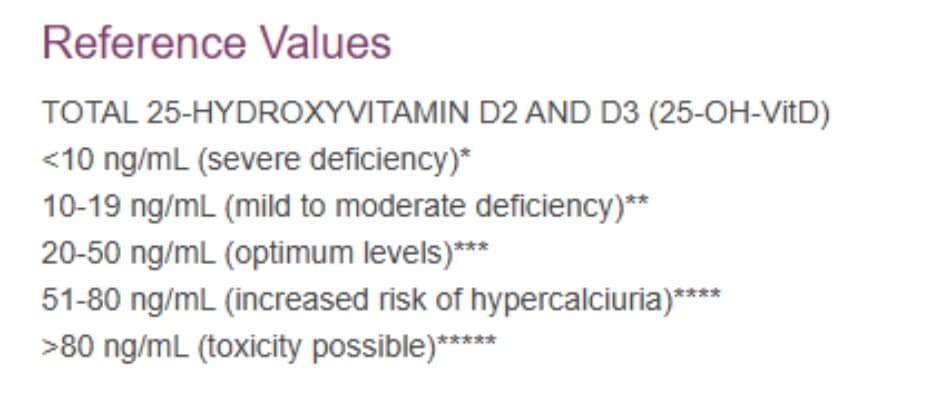
So, there’s some conflicting information. Here’s where you look at the information and work with your health care provider. Consider having a test done so you know where you’re at, and understand how to maintain optimum levels.
How Best to Supplement with Vitamin D3
You’ll often see vitamin D supplements for sale that contain K2. This is because K2 helps direct calcium to the bones and teeth and prevents it from depositing in arteries. If you’re taking vitamin D without K2 it’s best to also then buy K2 as a separate supplement to take alongside D.
Take vitamin D supplements with food, and with fat of some kind for absorption, because vitamin D is fat soluble. Also taking magnesium with vitamin D can help activate and metabolize the vitamin. Lastly, it’s important to stay hydrated (as a general rule) but also to prevent rare instances of kidney stones.
Can’t I Just get my Vitamin D From Sunlight?
Yes, however, in northern latitudes during the winter, getting enough from sunlight can be difficult at best. Additionally, even in the summer, many people aren’t out in the sun and therefore not achieving enough vitamin D. Remember, 42% are vitamin D deficient.
Potential Implications
I can’t help but wonder what America would look like if everyone maintained optimum levels of vitamin D. How many billions in health care dollars might be saved. How many people might not develop diabetes, inflammatory conditions, dementia and obesity. How the COVID-19 epidemic may have looked. How many sick days would be avoided.
This is a simple, effective and cheap thing all of us can do for our health and I encourage you to investigate on your own the benefits and risks of vitamin D supplementation.
Lastly, I have nothing to disclose. I’m not selling anything, nor did I use AI to write this article.
Referenced studies and articles: