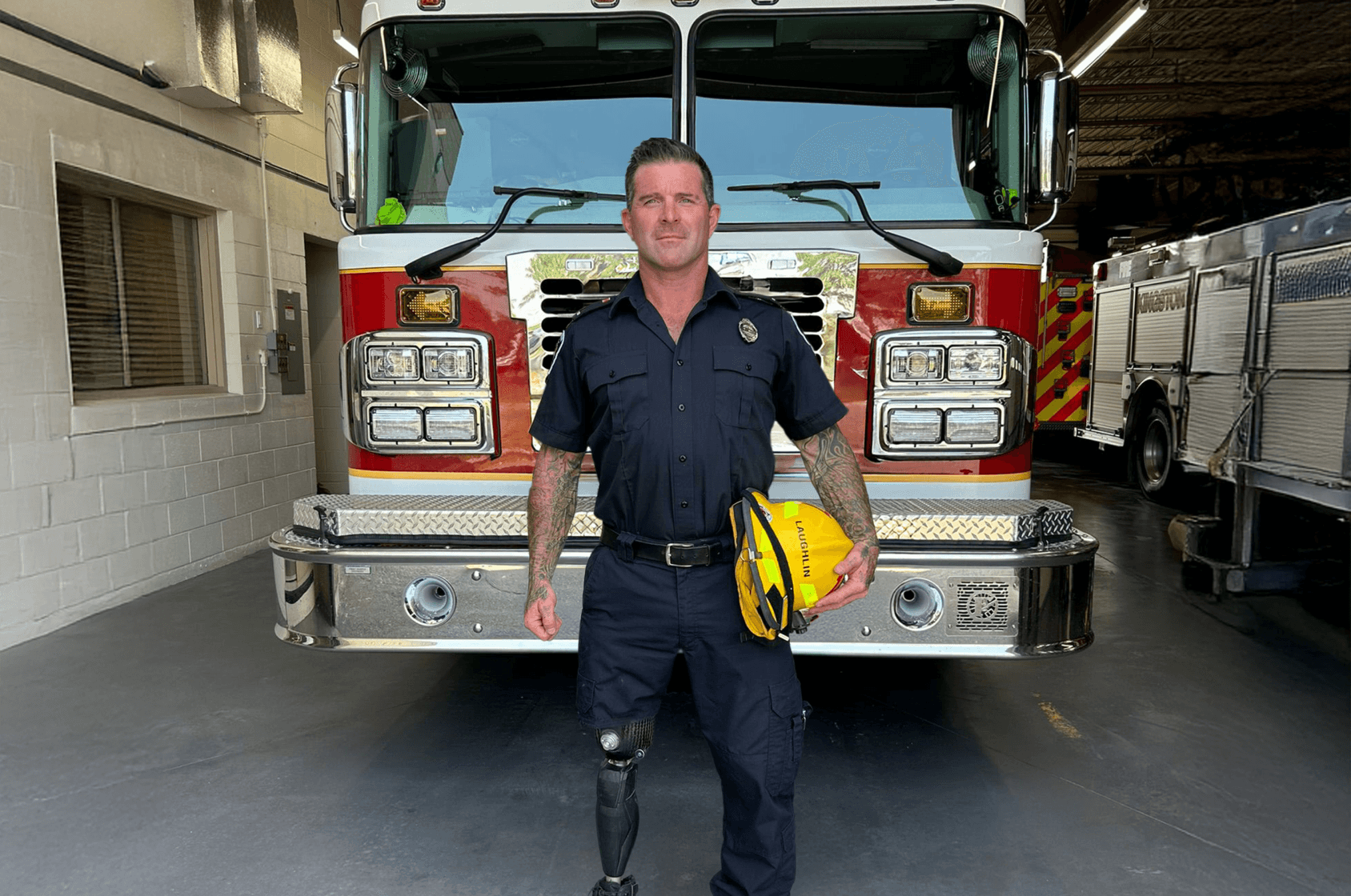
Michael Laughlin knew exactly what to do. Lying in a ditch near Kingston, Ont., with his right leg torn off at the knee after a deer struck his motorcycle, he relied on his firefighter training: call for help, give your location, apply a tourniquet. That training kept him alive, but recovery demanded something else.
Laughlin, 45, is a full-time firefighter and acting captain with Kingston Fire and Rescue. He’s poised to become a full captain soon. He’s also Canada’s first above-knee amputee to return to full-time firefighting. That distinction led to interviews, profiles, and the documentary You Were There for Me.
His story is extraordinary not only because of the trauma but because of the deliberate choice he made not just to survive, but to thrive.
At 26, a decade before the motorcycle accident, a snowmobile accident shattered his femur, tibia, fibula, kneecap, and ulna. In between the two accidents, Laughlin lost his girlfriend of four years to suicide, fell into opioid addiction, and was arrested for buying illegal painkillers.
So he has a lot to talk about, including what firefighters rarely talk about: the headspace between getting hurt and the return to duty.
Before his traumatic injuries, Laughlin’s identity was simple and solid. He grew up on a farm, played competitive sports from childhood into adulthood, and built a reputation as someone who could take a hit and keep going. “I thought I was invincible,” Laughlin says. “I just thought I could do whatever I wanted and nothing would ever hurt me.”
Firefighting fit that identity. Everything Laughlin did – co-ops, volunteering, dispatch work – was aimed at getting on the job. He became “Mike the firefighter,” the guy who would run into a fire or do anything to help someone else.
The snowmobile accident gave that version of himself its first serious blow.
In both accidents, the physical damage was obvious — he now has a prosthetic leg, a titanium plate in his arm, a titanium rod in place of his femur, and 33 pins and screws holding everything together. The psychological damage was less visible.
“I’m now the victim,” Laughlin recalls thinking after the snowmobile accident. “I never wanted to be a victim.” So he decided to “flip the script on that. I’m going to beat whatever they put in front of me.”
That included the loss of his leg. Surgeons had reattached it, but there was no blood flow.
“It wasn’t part of me,” Laughlin says. “I didn’t even feel it. And when they went to amputate, I grieved for a little bit, for about an hour.”
“I thought I was invincible.”
Then he asked his dad to look up the best prosthetic leg in the world. The search results revealed an image of a Green Beret in a prosthetic leg that looked like something out of The Terminator. “It’s amazing,” Laughlin says. “And he’s this big, strong guy. I’m like, ‘I’m going to be that guy. And I’m going to be a firefighter.’ I had already decided … I wasn’t going to be a victim. I was gonna beat it.”
Laughlin realized he was actually reinventing himself. When he decided he was going to be Canada’s first above-knee amputee to return to full-time firefighting, he did some research. He found amputees who tried volunteer firefighting.
“The physical testing is much, much lower as a volunteer,” Laughlin says. “It’s so competitive for full-time that the athleticism you have to have, and the strength, is top notch. And I had to pass that test.” If he couldn’t pass the test (without modifications), “I don’t want to be out there slowing down my team or being a liability to my team. I was determined … I was going to pass, no matter what.”
That kind of resolve didn’t come out of nowhere. Laughlin says it was shaped early, by growing up on a farm and reinforced through sports. “I don’t like to lose, and I always played at the highest level of sports.” (He was captain of a fastball championship team). “I was always a leader. I took a lot of pride in being a leader. It was like, ‘No one had done this before. Well, I’m going to lead the way.’ I’m going to show people that no matter what you’re going through, you can beat it. If you have a positive attitude and you want it badly enough.”
The mindset that helped him survive didn’t make recovery easy, though. He remembers his first day of physiotherapy after the snowmobile accident. In his head, he had already mapped out the plan: get up, walk the floor, do pushups, and get stronger.
Instead, the therapist helped him sit on the edge of the bed.
“They’re like, ‘Great job. That’s Day One,’” he says. “And I was so discouraged and disappointed! The next day I stood up on my legs, and they held me, and they’re like, ‘That’s a great Day Two! And I’m like, ‘What? I was planning on running today!’ I had to take a step back and realize, OK, today I’ll do one step, tomorrow I’ll do two, then I’ll do four, and I’ll keep doubling that.”
Laughlin returned to work after the motorcycle accident by passing those same physical tests as everyone else. “I just trained. The more repetitive stuff you do, the better you get at it. It goes for anything. I did the drills over and over until I got confident in it. I’m very confident in my leg now. I put it on in the morning and I go, but I still have slip ups.”
Today, his crew often forgets he has a prosthetic leg at all, which Laughlin says is the greatest compliment. But doubt lingers.
“I have to push it away,” Laughlin says. “Say we’re going up 10 flights of stairs. I’m like, ‘Oh, can I do this?’ And then you gotta pep talk yourself and be like, ‘Yep, you can do this. You’ve done this before. At least you’re going to try. Don’t give up.’ I think all amputees have that little bit of doubt or uncertainty that creeps in once in a while, but you just got to work through it. That’s the only way; we have no choice. The leg’s not growing back. If I lay down and gave up, people will see that, and they would think that’s OK. And it’s not OK … I try to be the first one up those stairs, even if it hurts my left leg so bad and it’s burning, I ignore it. And I get to the top just to prove a point. I’ve always had that mentality that everyone’s watching, and I have to be a good example.”
Laughlin also accepted something many firefighters resist: Help.
Kingston Fire and Rescue’s return-to-work program allowed him to come back on shift in a modified role, enabling him to stay connected to his crew. “I think every department should adopt that,” he says. “Because you still feel part of the team. And that’s a big part of it; when I was out, I missed it.”
Isolation is one of the biggest threats injured firefighters face, especially mentally. Laughlin saw it firsthand in the hospital: patients with no visitors or support, no one telling them they’d be OK.
“No wonder people get depressed and they don’t recover very quickly or at all,” he says, and highlights the power of developing relationships. “When you do that, you have a support team … you’re always getting picked up. Everyone who came (to the hospital) were like, ‘Hey, Laughie, if anybody can do it, you can. If anybody can get back from this, you can get back from this.’ When someone says that to you, you feel obligated to make a big effort to get back. At least I did.”
And remember Laughlin’s girlfriend died by suicide and he developed an addiction to pain medications. “I was using them to function,” he says. And then he got arrested. Just one of those events can be very isolating.
He credits his family with pushing him to beat his addiction. It was the motivation he needed to begin to rebuild his life through small, consistent habits: going to the gym, eating well, and focusing on routines. He also went to a clinic, a tough move as a public figure (i.e., firefighter, athlete), he didn’t want to be seen. So he went to a clinic out of town, and he got help.
Eventually, the case against Laughlin for buying illegal painkillers got thrown out (his job stood up for him, knowing what he’d been through), but going to court a bunch of times gave his ego a beating. “There’s no hiding this: he’s a drug addict and a criminal.” It took a lot to get past that, he admitted in an interview with From the Depths of Darkness To the Light of Success. “I always say now, time heals everything. In two weeks, someone else is going to be the big story.”
Laughlin’s advice to firefighters navigating uncertainty or injury is to ask for help, and go through the right avenues.
“If you’re injured, don’t shrug it off. Don’t be afraid to ask for help and get yourself healed up,” Laughlin says. “Don’t worry about what other people think. Worry about yourself, because you’re very valuable to your family, and you’re valuable to your team. We need you at your best shape and your peak performance.”
Untapped 60: A Profound Shift In Perspective
Laughlin now shares what he’s learned through his book, Untapped 60, co-written with his best friend, Jarrett Robertson. It encourages people to face vulnerability and build strength through adversity. He also speaks at events across North America, sharing his story as proof that it’s possible to overcome challenges and build a meaningful life, just like he has. One day, one step, and one staircase at a time.