Heavy rooftop equipment and cockloft fire are a dangerous combination, making early roof reports, decisive command, and timely withdrawal critical to firefighter safety
Let’s look at and consider the strategic impact of roof loads.
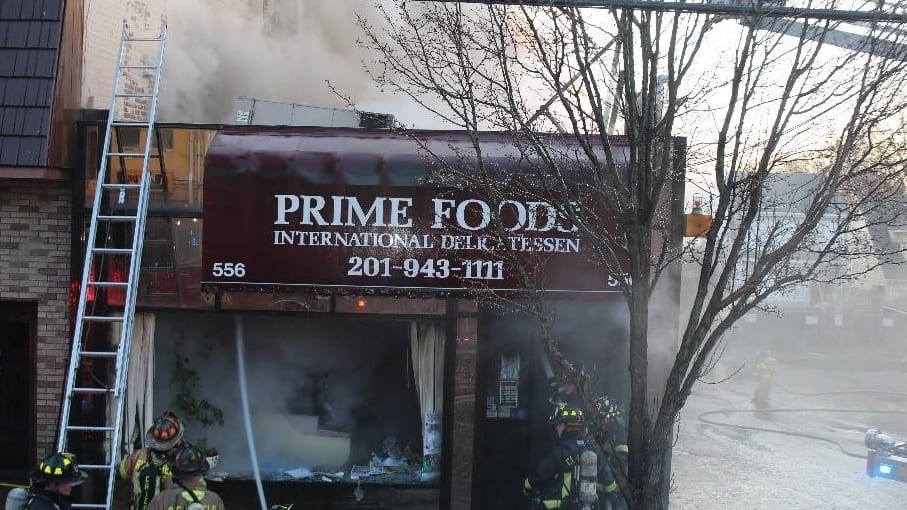
In the photo above, we have a one-story commercial structure which some may call a taxpayer. It appears to be an ordinary construction. The lines appear to be directing streams up toward the cockloft. There are some things here on this alpha side that somebody needs to take notice of … and fast.
I am a big fan of the command post being positioned at the front of the building, or at least in this picture off to the right, where you can see two sides. An IC inside the command vehicle down the block somewhere is not going to see these things. Command presence requires street presence. Vince Lombardi never coached the game from the locker room.
I don’t know if the incident commander was at the front of the building here or not, but if he or she wasn’t, the only person aware of the air conditioning unit sinking through the roof is the photographer. The firefighter on the tip of the TeleSqurt is paying attention to his task and the firefighters on the street are not aware of the condition from where they are positioned. A ladder has been raised to the roof so there is a possibility that someone is on the roof and hopefully they will notice it. It appears though, however, that in order to get back to the ladder for egress, they probably have to pass the sinking air conditioning unit. This is why it is so important to establish secondary means of egress from the roof as soon as possible.
I would expect the ladder company accessing the roof to immediately give a report (maybe an urgent report) about the HVAC unit. With the location of the fire (appears to be in the cockloft) and the presence of the heavy load on the roof, I would be pulling the plug on the roof and on any operations inside or close to the building and going defensive.
Fires on the top floor or in the cockloft + heavy loads on a roof = withdrawal and collapse zone establishment.
Things can happen too fast.
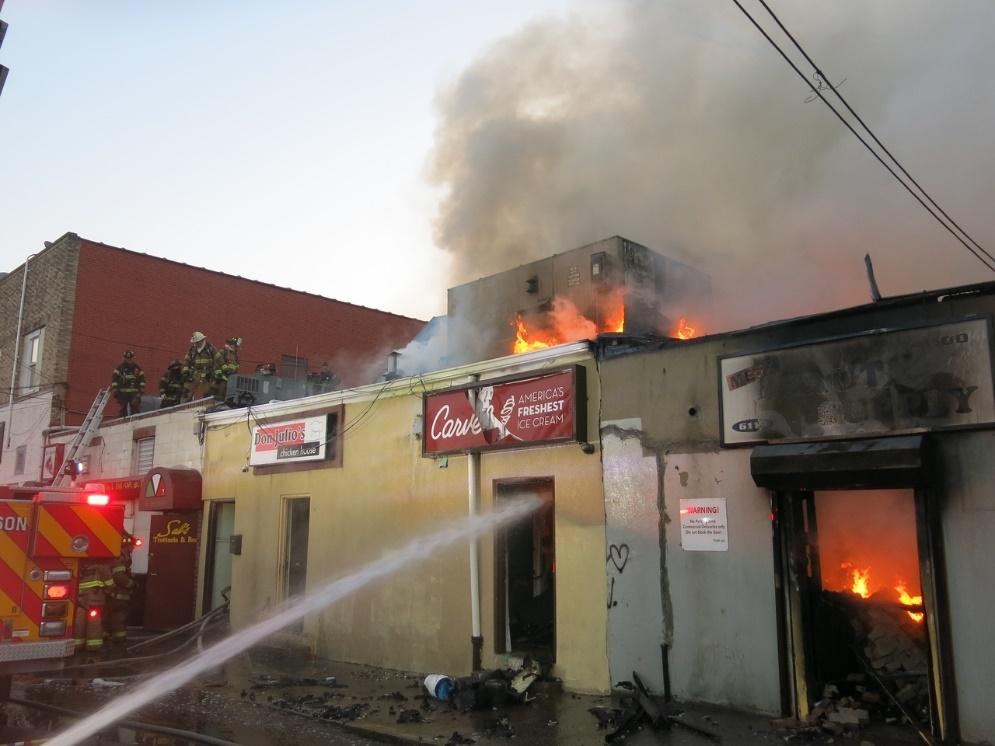 Photo by Ron Jeffers
Here is another shot of an HVAC unit in an extremely compromised position. Fire is venting through the roof below the unit. This is a loser. The ice cream will melt. Defensive operations are occurring. Companies along with the roof division commander are on the roof to the left which would actually be the delta exposure because we are looking at the rear of the buildings.
No one on that roof should be venturing anywhere near the threatened unit and an immediate, preferably an urgent message should go out to the command post. There does appear to be a unit on the roof where the companies are standing and that exposure does not yet appear to be involved. Continuous monitoring is necessary should the exposure they are standing on become threatened and/or involved.
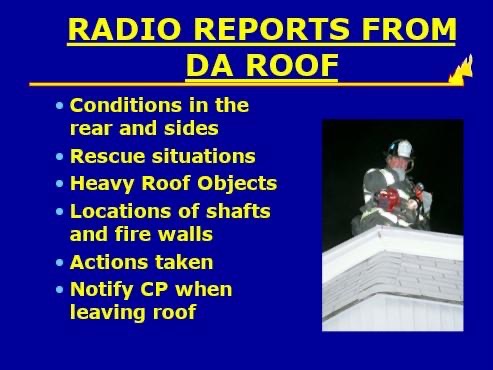
At all incidents where roof operations are required, a radio report must be transmitted when the Ladder company accesses the roof, establishes the Roof Division and conducts a size-up. The report must include roof conditions, as well as life hazards in the rear or on the sides of the building, the roof construction, presence of air and light shafts, and a report on roof loads. Roof loads are often only seen from the roof. Good pre-fire street intelligence will pay big dividends for the engaged company who knows their area.
Of critical importance are the buildings that did not have those loads on their roofs when they were built. Added on HVAC units, placed on the roof of an old building are almost never reinforced. Companies operating inside the building, especially on the top floor, must be made aware of the presence of loads on the roof. Gravity never takes a day off. The slide below includes radio report information that is critical to the operation.
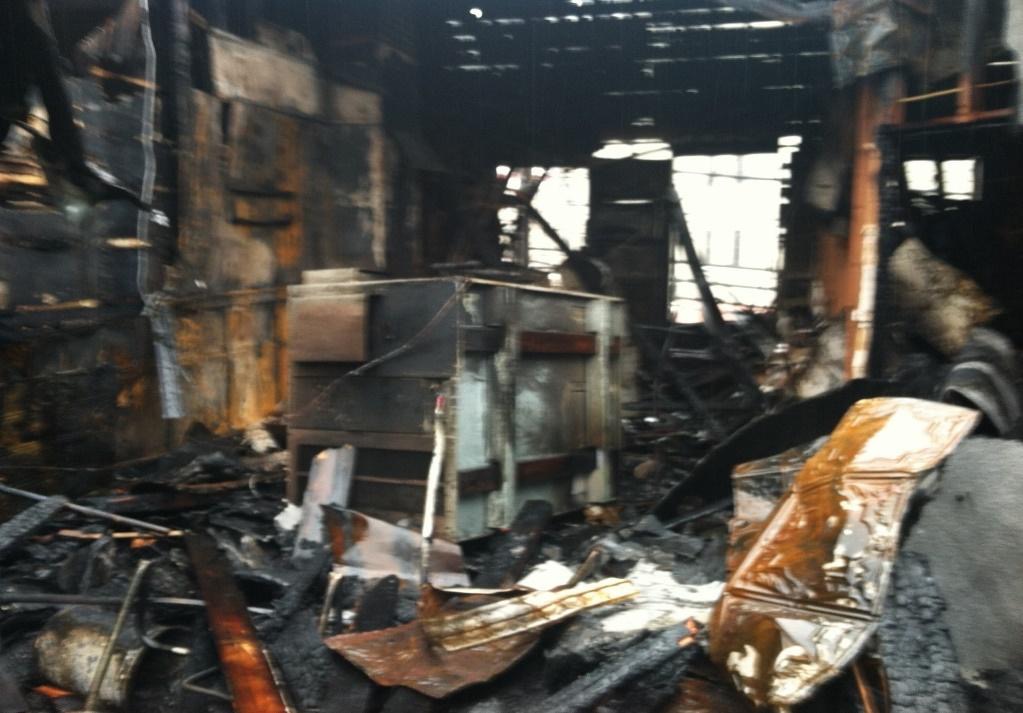
We had a job in an old two-story frame that was once a taxpayer but was converted to a multifamily residential. There was heavy fire which spread from the first to second floor and into the cockloft of the fire building and the exposure on the bravo side. The Roof division report included an HVAC unit on the roof of the fire building, as well as heavy fire in the cockloft. Once command had this information, companies were withdrawn. The photo below shows how critical that report was. The HVAC unit is now on the top floor. That would have hurt.
“We only become aware of a void in our knowledge when we begin filling it.”
Anthony Avillo, MS, with over 40 years in the fire service, retired as deputy chief of North Hudson (NJ) Regional Fire & Rescue after 30 years of service. As an urban fireground commander, Avillo commanded fire and emergency operations in the most congested cities in the United States. He is the author of Fireground Strategies, 4th ed. (2025), and coauthor of Full Contact Leadership (2017). Avillo is a former Region 3 Director of the ISFSI and retired Director of the Monmouth County (NJ) Fire Academy. He is a member of the Fire Engineering / FDIC Editorial Advisory Board and was the recipient of the 2012 IFSFI George D. Post Instructor of the Year Award. He has a B.S. degree in fire science and an M.S. degree in national security studies. Avillo is a level II NJ Certified Fire Instructor. Avillo also speaks around the United States and Canada on such topics as Command and Control, Leadership, Building Construction, Fireground Strategies and Tactics, and Operational Safety.