
Why Longitudinal Studies Matter for Firefighters' Health and Safety
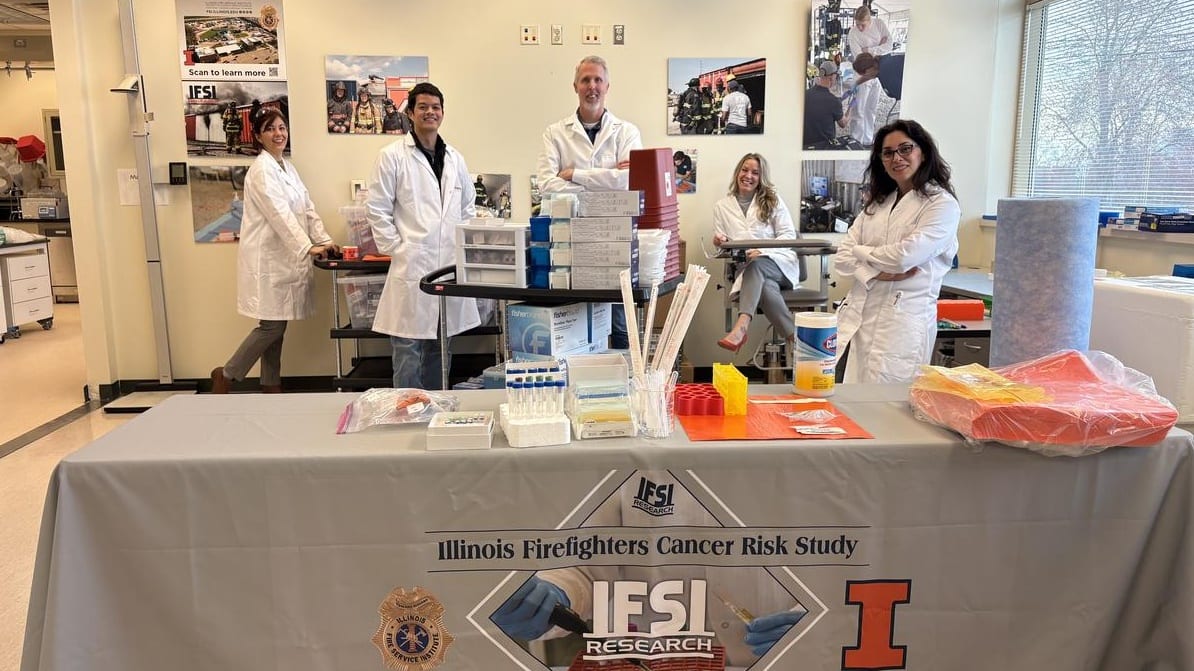
The IFSI Research Laboratory Team launch their Illinois Firefighters Cancer Risk Study (IFCRS). Left to right: Dr. Neda Seyedsadjadi (Research Scientist), Dr. Dac Nguyen (Fire Engineer), Jason Rennert (Project Manager), Dr. Crystal Sweeney (Analytical Toxicologist), and Dr. Farzaneh Masoud (IFSI Director of Research) (Fall 2024).
Long-term research is uncovering the cumulative health risks firefighters face, and shaping smarter protections for the next generation of the fire service
You may recall from our previous article that the Illinois Fire Service Institute at the University of Illinois Urbana-Champaign has established a state-of-the-art laboratory devoted to firefighters’ health and safety. This article is about you and how this state-of-the-art high-tech laboratory is being used to follow the health of firefighters over time, capturing the exposures, stresses, and physiological changes that come with the job.
Through longitudinal (long-term) studies, we are working to better understand the health risks you face throughout your career and how that knowledge can help keep you healthier on and off the fireground.
Firefighting is a long game. Firefighters are repeatedly exposed to toxic smoke, carcinogens, extreme heat, physical strain, sleep disruption, and psychological stress. Unlike burns or injuries, many of the most serious health consequences, such as cancer, cardiovascular disease, and chronic respiratory illness, develop slowly, often surfacing years or even decades after the exposure occurred.
Short-term or cross-sectional studies provide information that represent only snapshots in time and fail to capture the delayed and cumulative nature of firefighting-related health risks. In contrast, longitudinal studies, which follow the same firefighters over many years, are uniquely suited to reflect the true nature of the health risks associated with firefighting career.
Firefighters understand risk better than most. They train for it, mitigate it, and accept it as part of the profession. What takes longer to understand, however, is how those risks continue to affect the body long after the last call. Longitudinal studies bridge that gap by connecting today’s exposures to tomorrow’s health outcomes, a crucial step in protecting not only current but also future firefighters throughout their careers and into retirement.
What are Longitudinal Studies?
Longitudinal studies follow individuals over time, sometimes from recruit training through retirement and beyond. This approach allows researchers to observe how repeated occupational exposures accumulate and how these exposures impact health changes across the lifespan of a firefighter.
For the fire service, long-term studies help answer five critical questions:
How do cumulative exposures affect cancer risk?
When do cardiovascular risks begin to increase?
Do early-career exposures influence post-retirement health?
Which safety interventions actually reduce long-term illness?
How to mitigate the cumulative exposure?
These are questions firefighters have been asking for years. Longitudinal studies can provide the answers.
Moving from Correlation to Cause
One of the greatest strengths of longitudinal studies is their ability to help establish cause-and-effect relationships, not just correlation. Correlation is when things happen at the same time. If you are sitting in the sun for a few hours and your face gets sunburned, there’s strong scientific evidence that the sun caused the burn. Now, while sitting there, you also scratch off a winning lottery ticket. A lot more research will be needed to prove that sitting in the sun causes lottery wins and it wasn’t just coincidence.
Rather than simply showing that firefighters experience higher rates of certain diseases, these studies can link specific job-related exposures, such as years of interior firefighting, frequency of fireground operations, or high call volume to later health outcomes.
This level of evidence is essential for:
Strengthening PPE standards
Supporting presumptive cancer legislation
Improving medical screening and early detection programs
Informing policy, operational, and funding decisions
In short, longitudinal studies turn firefighter experience into defensible science.
Health Risks Change Over a Career
A health-risk profile of a firefighter is not static. Recruits face intense physical demands, active-duty firefighters accumulate repeated exposures, and retirees may experience delayed health effects years after leaving the job. Longitudinal studies capture this entire career arc.
By examining data across career stages, researchers can identify:
When exposures are highest?
When and how prevention efforts are most effective?
How aging interacts with the physical demands of firefighting?
How early-career exposures can compound and lead to later health issues?
This information allows departments to design wellness programs, screenings, and interventions that evolve with a firefighter’s career rather than relying on one-size-fits-all solutions.
Longitudinal studies have already contributed to meaningful improvements across the fire service, including:
Enhanced turnout gear and PPE design
Improved decontamination and station-cleaning practices
Increased attention to cardiovascular health
Expanded cancer awareness and screening efforts
Longitudinal studies provide department leaders and policymakers with clear, long-term evidence demonstrating that certain practices reduce illness or mortality, ultimately paving the way for investments that protect firefighters’ health.
The Unique Challenges Female Firefighters Face
Longitudinal studies are especially important for understanding the health risks female firefighters face by — a group historically underrepresented in fire service research. Differences in physiology, hormone regulation, body composition, and PPE fit may influence how exposures affect health outcomes over time.
Female firefighters may face additional challenges, including:
PPE and turnout gear not designed for female body types
Differences in carcinogen absorption and metabolism
Reproductive and hormonal health concerns
Increased risk of certain cancers that have been understudied in the fire service
Without long-term data that intentionally includes female firefighters, these risks can remain invisible. Longitudinal research helps ensure that health and safety strategies are evidence-based and inclusive — protecting all members of the fire service.
Identifying High-Risk Groups
Not all firefighters face the same level of risk. Longitudinal studies allow researchers to identify higher-risk groups based on factors such as:
Job assignment (suppression, command, engine operator)
Call volume and incident type
Years of service
Age, sex, and physiological factors
Decontamination practices
This enables targeted prevention strategies rather than broad approaches that may overlook those most at risk.
Measuring What Works
Fire departments invest significant time and resources into health and safety initiatives. Longitudinal studies help answer a critical question: Are these efforts making a difference?
By tracking firefighters over time, researchers can evaluate whether changes (such as improved gear cleaning protocols, wellness programs, or operational adjustments) actually lead to reductions in illness, injury, or death.
Firefighting will always involve danger, but preventable illness should never be the price of service.
Longitudinal studies allow the fire service to look beyond the next alarm and focus on a firefighter’s entire life of service – and beyond. By investing in long-term research today, we help ensure a healthier, safer future for firefighters tomorrow.
Dr. Farzaneh Masoud, Director of Research at IFSI, has earned her PhD from University of Illinois Urbana-Champaign from Department of Molecular Biology. She has a broad background in molecular, cell and developmental biology, as well as mammalian reproductive biology. Her doctoral research focused on identifying factors that underlies cancer metastasis. Dr. Masoud joined Illinois Fire Service Institute as the Director of Research in 2019, where she leads numerous research projects concerning the health and safety of firefighters. Prior to joining IFSI, Dr. Masoud led large interdisciplinary projects at National Center for Supercomputing Applications (NCSA) as a Strategic Research and Proposal Development office and has served as an Interdisciplinary Research Development Officer.