
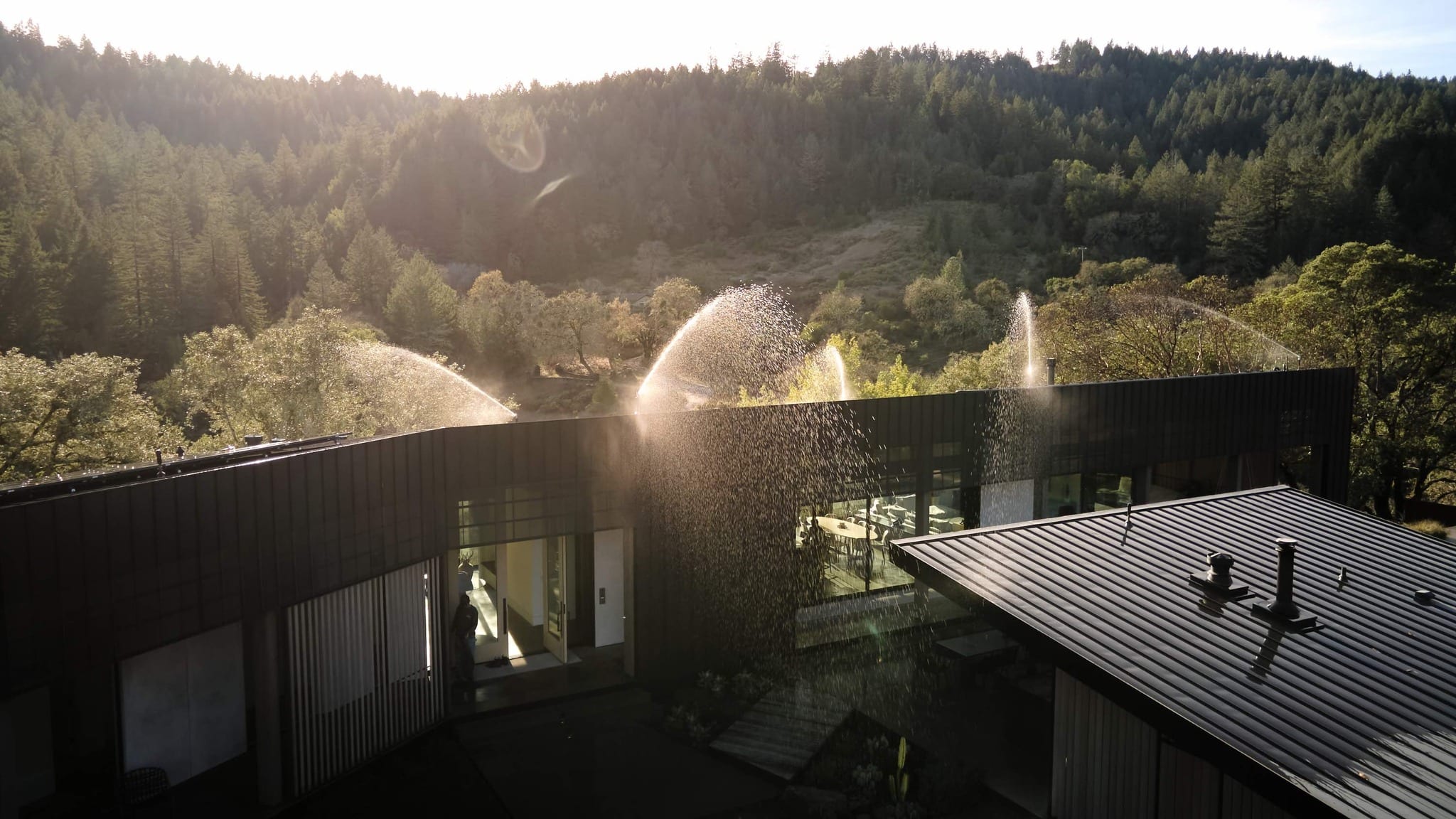
Frontline Wildfire’s Defense System 2 is one of several new home protection technologies emerging amid heightened wildfire concerns.
As the L.A. fires proved, homeowners taking advantage of a new crop of home fire defense technologies improve odds for home survival
By Jon Hughes, CRACKYL Contributor
Every firefighter who has defended a structure from wildfire knows the frustration of limited resources. When fire seasons stretch longer and fire crews are pulled thin, the harsh reality is that not every home can be saved. The recent L.A. wildfires reinforced what many firefighters already understand: homes in the wildland urban interface (WUI) that are prepared ahead of time have a far better chance of surviving. Now, some homeowners—including firefighters themselves—are turning to active fire suppression technology to take that preparation to the next level.
For WUI residents, particularly firefighters who know the risks firsthand, investing in these emerging technologies could be the difference between rebuilding and coming home to an intact house.
How Home Fire Suppression Systems Help Firefighters
For fire crews, homes equipped with active suppression systems aren’t just easier to protect—they allow for smarter, safer decision-making in the field. When homes can defend themselves before firefighters arrive, crews can prioritize containment instead of risking aggressive structure defense operations.
More importantly, these systems reduce last-minute rescues and limit the number of fully involved structures, giving fire crews the upper hand in fast-moving wildfire conditions. As witnessed in the L.A. wildfires, fires often outpace suppression efforts, making self-defending homes a critical part of WUI survival.
Fire Suppression Systems Worth Considering
A growing number of fire suppression systems are designed to work before the flames reach a home, adding an extra layer of defense. Here are three options that stand out in technology, functionality, and real-world application.
1. Frontline Wildfire Defense System
Best for: Remote activation and wildfire prep
Frontline’s Defense System 2 is one of the most advanced home wildfire defense systems available. Unlike standard rooftop sprinklers that spray water, Frontline uses a biodegradable, non-toxic fire-retardant foam to coat a home’s most vulnerable areas—roof, gutters, siding, and surrounding vegetation.
The system can be remotely activated via a mobile app, meaning homeowners can deploy protection even if they’ve already evacuated. It also maximizes water efficiency, applying the retardant only when needed, rather than running continuously.
For WUI homeowners—particularly firefighters who understand the unpredictability of wildfire behavior, having the ability to control suppression efforts from anywhere is a major advantage.
2. WaveGUARD Fire Suppression System
Best for: Creating a high-humidity fire barrier
Developed for both homes and businesses, WaveGUARD‘s core protection comes from its patented, fully autonomous sprinkler spray platform that applies a 100% safe, plant-based, long-term fire retardant (only available in North America from waveGUARD)to the entire structure in less than one minute.
In addition, waveGUARD is an active wildfire defense system. Once activated, it continues to operate throughout the wildfire event, actively fighting to protect the property and structure until the threat has passed. This happens automatically, without any human intervention.
For firefighters familiar with how quickly embers start spot fires, a system that proactively alters fire behavior before it reaches the structure is an intriguing option.
3. FireBozz Mobile Sprinkler System
Best for: Flexible, deployable protection
For those looking for a more portable, multi-use option, the FireBozz system functions like a high-powered mobile sprinkler. These units can be placed around a home’s perimeter or near critical infrastructure and can spray water in a full-circle pattern up to 100 feet.
Unlike permanent systems, FireBozz can be set up and repositioned as needed, giving homeowners flexibility depending on the fire’s approach. It’s a strong choice for those who want an added layer of protection but don’t want to install a full home system.
Investing in Protection: What Firefighters Should Consider for Their Own Homes
For firefighters living in wildfire-prone areas, investing in an active suppression system isn’t just about protecting property—it’s about protecting everything you’ve worked for.
When considering a home system, key factors include:
- Activation Method – Do you need a system that activates remotely, automatically, or on-site?
- Water vs. Fire Retardant – Some systems use only water, while others apply a fire-retardant foam for longer-lasting protection.
- Coverage Area – Does the system protect just the home, or also vegetation, fences, and outbuildings?
- Integration with Firefighter Response – Systems like Frontline and TORCH work best when they support—but don’t interfere with—fire suppression efforts.
The L.A. wildfires have made one thing clear: prepared homeowners, armed with the right technology, have a better chance of keeping their homes standing.
As a firefighter, you know better than anyone that when the flames hit, it’s already too late to prepare. For those of us living in wildfire-prone areas, investing in an active home fire suppression system isn’t just a precaution—it’s the best way to ensure we come home to something still standing.
Because when it comes to wildfire defense, being proactive isn’t just an advantage—it’s survival.
About the Author
Jon Hughes is a veteran journalist and media executive with over two decades of experience in digital publishing, public safety media, and content marketing. Currently, he advises media and tech companies on content strategy, digital transformation, and audience growth.