
How much of winning is mental? This is a question that every athlete has had echoing through their head since the dawn of their sports career. Ninety percent, 95%, or 110% (not possible, by the way) are all numbers thrown around, but all agree that most winning is mental.
Many top-level athletes, Olympians, and teams have access to roughly the same level of coaching, weights, trainers, nutrition, and supplements. So what separates the winners from the losers? The mental game.
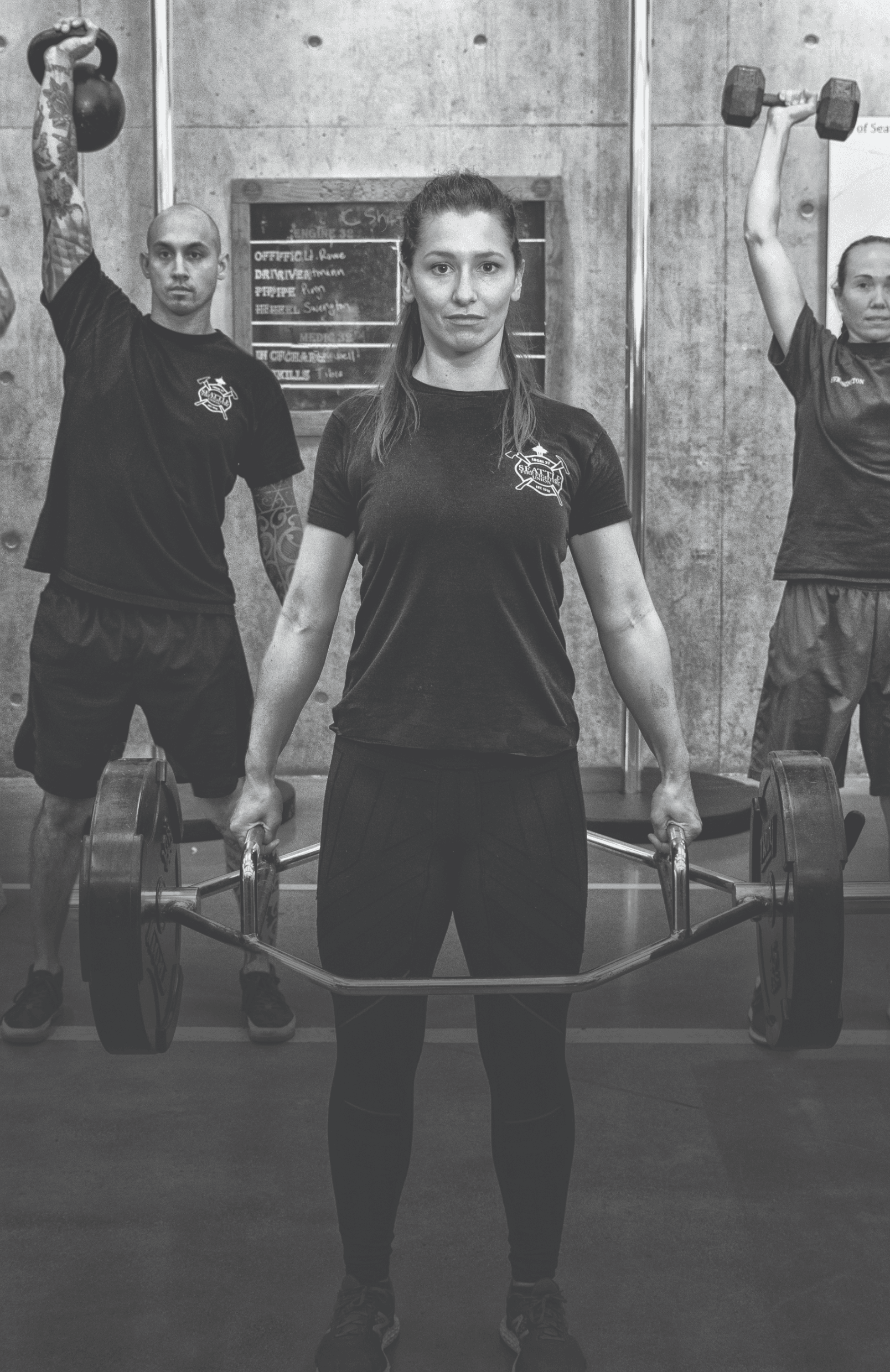
If we asked most firefighters if physical training or drilling is important, they would answer yes. If we asked the same question of mental training, the answer is yet again, most often, yes. Now if we asked how many hours firefighters spend mentally training versus physically training, the answer is very different.
Most firefighters, like athletes, spend 90% of their training on the physical and only 10% (if any) on mental training. If mental training is a difference-maker, then why don’t we train it more? This is a challenging question for any athlete or firefighter and should serve as an eye-opener.
Over the next year, I will share The 6 Cs of Mental Performance, which apply on or off the fireground: Composure, Confidence, Concentration, Conditioning, Consistency, and Contemplation.
The first 3 Cs I learned from a mentor and fellow firefighter, a man known as “The Coach.” These first 3 Cs are employed during the fight, game, or fire. The second 3 Cs I have developed to support post-game, post-incident evaluation, or performance growth. These 6 Cs are not shared as gospel, but as what has worked for me, what I have learned, and what I have taught to new recruits in the Drill Tower. What goes on in the head directly translates to what goes on at an incident or field of play. Winning is not an option, it is a choice.
Composure
It was 23 years ago, my second day assigned as tiller on Truck 7. The truck driver was the Senior Man, a 20-year veteran of Oakland Fire. The Klaxon goes off for a structure fire, I shoot down the pole and get on the rig, two beeps, and we are out of the barn.
“Smoke showing from the firehouse,” my captain said over the radio. I play out my job in my head: first, don’t hit shit and get there. Then, ladder building and help the Senior Man cut a hole. Simple. I can feel my heart pumping and my mind starting to swim as my captain’s words echo in my head: “Act like you’ve been here before, kid – take a second and breathe.”
Composure, like I have been here before, “been there, done that, nothing to get excited about.” Take a second and breathe. Self-regulate through breath and focus. Wise words indeed from my captain.
The air brakes pop, I jump off, grab the ladder, and make the throw. The Senior Man goes up first and foots the ladder from the top for me. “Come on up, kid.” As I get to the top of the ladder, I am wide-eyed. The roof is just black smoke and flames, licking from the windows on the alpha side. I had a moment of panic, my mind swimming again. The Senior Man looked me in the eyes and smoothly said, “Don’t worry, kid. Just step where I step. If I fall through,” pause, giggle, “then don’t step there,” then the Senior Man proceeded to move like a cat on the roof. A few steps later, smoke enveloped him.
It was the captain’s words and the Senior Man’s demeanor that created the composure I needed. Neither the captain nor the Senior Man were calm, they were composed.
“Calm is contagious” is a catchy tagline, but composure is not calm. Composure is where true performance lies. Composure, like the other Cs, is the balance point where peak performance can thrive. The balance between calm and complacent versus excited and manic. Too calm, and we often miss important information or events. We under-commit. Too excited, and we hyperfocus on information. We overcommit.
This balance point is well understood and studied in the military special forces. Dave Grossman, a psychology professor at the U.S. Military Academy at West Point and former Army Ranger, studied the relationship between peak performance and heart rate.
Grossman’s studies reveal that composure relates to one’s heart rate. In short, optimal performance was between 115-145 bpm. Below 115 or above 145 and performance suffers, it is a balance. Above 175 bpm, and we will experience extreme loss of cognitive and complex motor functions, sometimes even bowel and bladder control. Think flight, fight, or freeze. This effect is in part due to the heart being unable to deliver a full amount of blood to the brain. Highly trained athletes and Special Forces operators can train to produce high-level cognition and motor function up to 175 bpm but beyond that, we all become victims of physiology.
So, what do we do? The first step is to understand that composure is intimately related to heart rate. Grossman’s connection between heart rate and performance is driven by psychological stress, not solely physiological stress. Then find ways to control heart rate and lower psychological stress. Simple, right?
Heart Rate Control: The Breath
The best way to control our heart rate is through the breath. The breath has a direct connection to heart rate. The rate of breath and the how of breathing are the important parts.
The rate is a direct link and simpler to grasp: a slower breathing rate equals a slower heart rate. Peak performance is a balance, and so is the breath rate. The rate should be steady with slightly longer exhales than inhales. Steady, not too fast and not too slow, will land your heart rate around 145 bpm.
The how of breathing, is a bit more nuanced. Nasal breathing only, and you will be too relaxed. Mouth breathing only, and you will be too excited. Again, we seek balance. Nasal in/mouth out (115 bpm or low end), mouth in/nasal out (145 bpm or high end), and mouth in/mouth out with longer exhales (145-175 bpm or well-trained highest end).
Now we have the raw ingredients: Steady and exhale-focused, alternating between the different breathing techniques as needed. There are times when mouth in/mouth out might be needed, but try to quickly return to using nasal in or nasal out.
A great way to train this is with a heart-rate monitor during your workout. Instead of every workout being max effort (CrossFit) start to implement two workouts at a 145 bpm target. Start to educate the body on what output at 145 bpm feels like. If we only ever train our bodies to work at max capacity, think HIITs or CrossFit, then when the tones go off and we get busy, our default mode is max capacity, aka, max heart rate. If this is our default mode, then our default mode is not one of peak performance.
Lowering Psychological Stress: Imagery Training
Good waves make good surfers. Fighting fires makes a good firefighter. We need to be in the game to get good at the game. But what do we do in lieu of good waves? Like my captain said, “Act like you’ve been there.”
The power of self-imagery training allows us to “be there” before we have “been there.” The brain will fire and wire the same neuron patterns whether we are imagining doing or really doing. Granted, doing something for real is always better, but we take what we can and don’t let the perfect stop us from the possible.
Neuroscience teaches us that imagery training works. Many of the greatest champions in history have used imagery training as part of their recipe for greatness. There is a great scene in the movie Cool Runnings where the Jamaican bobsled team captain is in the bathtub. He is imagining every turn on the course run. He is imagining every part of the run to perfection. Right turn he leans right, left turn he leans left, he is composed. It is time we start using imagery training in the fire service.
Sit or lie down, close your eyes, and imagine a fire or other incident. Really feel it, try to hear it, smell it, the more real you can make it, the better. Imagine seeing yourself in the third person, like you are observing yourself. See, feel, and imagine the chaos of a fire. See, feel, and imagine others around you “losing their cool.” Imagine yourself as cool and composed, in the perfect state of balance. Practice using your breath to keep yourself in this state, cool and composed. Imagine yourself as the beacon, the lighthouse of cool and composed energy. The truth of “calm is contagious” is that people feed off your energy and you are cool and composed. You are the high tower.
I have imagined myself on thousands of roofs, with everything going wrong, spongy, sagging, tar bubbling, and pipes growing. Fire coming out of every cut, shooting out of the hole. I have imagined having to bail off the roof thousands of times, too. Why? So when those days come I have a better chance of “keeping my shit” and being composed. So I can “act like I have been there before.” Because I have.
Join me in my next article as we dive into Confidence.