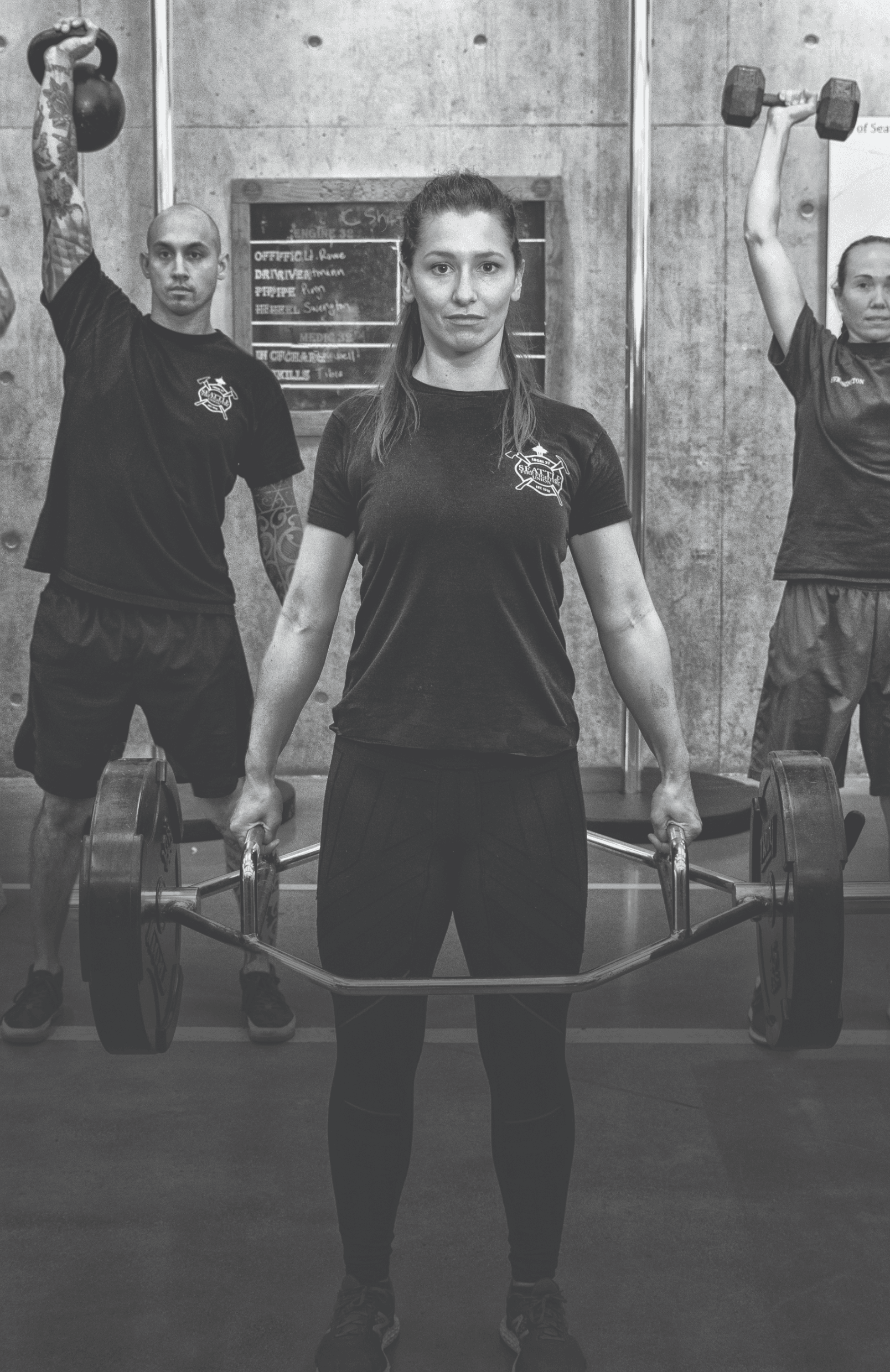


In his book Fire Department Incident Safety Officer, David W. Dodson draws a powerful distinction between arbitrary aggressiveness and intellectual aggressiveness.Arbitrary decisions – made impulsively and without context –can compromise firefighter safety. Intellectual aggressiveness, by contrast, is rooted in solid size-up,situational awareness, predictive thinking, and intentional action. That mindset leads to safer operations and better outcomes when it matters most.
The same principle applies to your fitness.Too many firefighters rely on random workouts – whatever’s trending online, a quick swipe from an app, or just showing up to “crush it” without a plan.
These sessions might leave you sweaty and sore,but that doesn’t mean they’re making you stronger for the job.
Without structure and intention, they don’t prepare you for the next call, reduce injury risk, or build the kind of strength and stamina you can sustain throughout your career.
No serious athlete prepares for competition without a progressive training plan. They train with purpose – following a strategy aligned with their goals, timelines, and performance demands. As firefighters – tactical athletes in every sense –we should approach our training the same way.
Your performance doesn’t just affect your safety. It affects your crew and the people counting on you.
In this job, fitness isn’t about vanity.It’s about being ready when lives are on the line.
It’s time to shift from working out to training with purpose.
Your performance doesn’t just affect your safety. It affects your crew and the people counting on you.
Working Out vs Training: What’s the Difference?
Not all physical activity is created equal. While both working out and training require effort, the intention behind them – and the results they produce – are very different.
Working Out Working out in this context means exercising without a plan – maybe a circuit you found online, a quick lift before shift, or a run just to break a sweat. That might be enough for the average person. But for firefighters, it’s not going to cut it. Random workouts don’t build the job-specific strength, endurance, or movement ability required on the fireground. They also fail to account for progression, recovery, and the adaptability needed to manage shift work and operational fatigue. Over time, this scattered approach can lead to injury, burnout, or poor performance.
Training Training, on the other hand, is intentional. It’s guided by specific goals and structured to improve performance over time. Smart training targets every component of firefighter fitness – movement quality, strength, conditioning, and resilience. It adapts to your schedule, supports recovery, and stays laser-focused on the physical demands of the job. The goal isn’t just to go hard. It’s to be ready.
The Science Behind Intentional Training
Effective training doesn’t rely on guesswork – it’s built on proven exercise science.Let’s unpack that science.
Progressive Overload is the foundation. Your body adapts when the challenge increases gradually, through added weight, reps, speed, or complexity. Without it, progress stalls and readiness suffers.
The Said Principle (Specific Adaptation to Imposed Demands) reminds us that you improve what you train. If you want to excel as a firefighter, your training has to prepare you for the real demands of firefighting.
Your training should account for the energy system requirements of the job, building both aerobic endurance for sustained effort and anaerobic power for intense bursts under stress.
Instead of isolating muscles, firefighter training should focus on movement patterns: push, pull, hinge, squat, carry, and rotate. These movements mimic fireground tasks and may be loaded using simple, functional tools like sandbags, kettlebells, and med balls.
Keep in mind that recovery and adaptation are just as critical as effort. Your body gets stronger after stress – if you allow time to recover. Without rest, you increase the risk of overtraining, injury, and burnout. Both occupational workload and training intensity must be factored into your total load.
Finally, training must be individualized. Your program should reflect your current fitness level, work schedule, injury history, and recovery capacity. One-size-fits-all doesn’t work for tactical athletes.
Just like an Incident Action Plan brings order to chaos on the fireground, the Firefighter Peak Performance Fitness Plan Framework brings structure, clarity, and measurable progress to your training. Firefighters don’t guess on the job, and you shouldn’t guess in the gym, either.
Size-Up: Measure Your Fitness Start with a baseline evaluation that reflects job demands, like the IAFF/IAFC WFI Assessment, the Firefighter Challenge, or the Firefighter Peak Performance Tactical Fitness Assessment. Know where you’re starting so you can train with purpose and track real progress.
Strategy: Select a Program That Fits Your Mission Firefighter fitness typically follows one of three strategies.1-Conventional fitness builds general strength and endurance through general physical preparedness.2-Functional fitness aligns training with job demands using specific physical preparedness.3-Tactical fitness develops real-world performance through job-specific physical preparedness. Choose the approach that matches your goals, duties, and current fitness level.
Tactics: Execute The Daily Plan Tactics are the day-to-day workouts that bring your strategy to life. Each session should target specific goals, such as strength, endurance, conditioning, mobility, or flexibility. Adjust intensity based on your periodized programming, shift schedule, and recovery.
Tasks: Job-Specific Movements Train the way you operate. Focus on essential movement patterns: push, pull, hinge, squat, lunge, rotation, and locomotion. Load these patterns with simple tools like kettlebells, sandbags, med balls, and steel clubs to prepare for real-world conditions.
After Action Report: Track, Reflect, Adjust The after action report helps us assess performance, capture lessons learned, and improve future response. Your fitness deserves the same level of accountability. Scoring the workout is part of the workout. Track how you feel, log your performance, and reflect on what went well and what needs work. This practice drives long-term progress and operational readiness.
You don’t need perfection. You need a plan – and the discipline to follow it.