
A statewide Zero Suicide framework is moving mental health out of the margins and into leadership, training, operations, and accountability
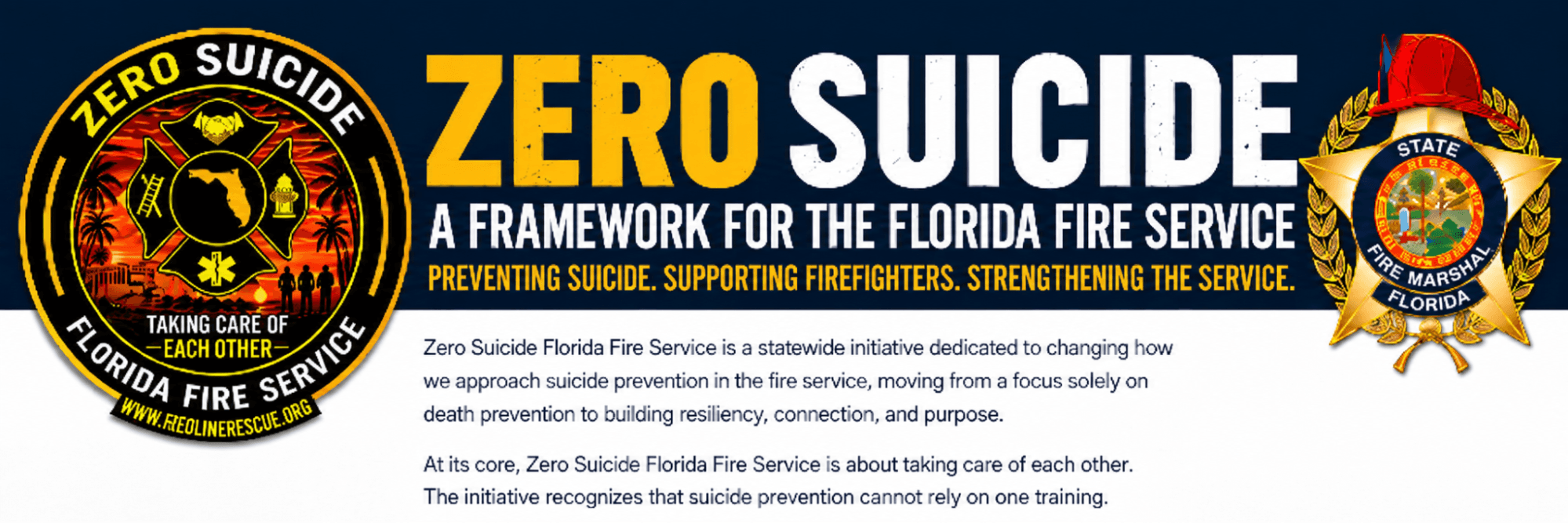
For years, firefighter mental health programs have often depended on the energy of a few people: a peer team, a chaplain, a chief willing to speak openly, or a clinician who understands the job. Florida is trying something larger. The Division of State Fire Marshal, working with UCF RESTORES and fire service stakeholders, has built a statewide Zero Suicide Framework. It has been designed to make suicide prevention part of how the fire service operates rather than something departments reach for only when a member is already in crisis.
The name is intentionally ambitious. In the framework, “Zero Suicide” is described as aspirational, rooted in the belief that many suicide deaths are preventable and should not be accepted as inevitable. The document acknowledges some may find the name controversial. But the larger idea is a shift in responsibility: suicide prevention becomes an organizational responsibility, with leadership, policy, training, access to care, and measurement all connected.
That starts at the top. In a July letter to Florida fire service leaders, division director JoAnne E. Rice wrote that recent tragedies had reinforced the need for “a proactive, statewide commitment to mental wellness and suicide prevention.” She also made an important point about the initiative: “This is not a program or a mandate.” The framework positions it as a leadership commitment and a systems-based approach, asking chiefs, officers, administrators, peers, clinicians, unions, families, retirees, and members themselves to operate as parts of the same prevention system, with members’ commitment integral to taking ownership of their own health and well-being.
The framework is based on the national, evidence-based Zero Suicide Initiative, and organized around seven elements: Lead, Train, Identify, Engage, Treat, Transition, and Improve. Each is tied to priorities, timelines, metrics, barriers, and proposed solutions. Leadership includes confidentiality policies, suicide-prevention champions, resource knowledge, peer check-ins, partnerships with vetted providers, and fostering a culture committed to building resilience, connection, and purpose. Training follows firefighters from the academy through retirement. Identification focuses on recognizing risk early and creating consistent referral pathways. Engagement is built around making support easier to find and safer to use. Treatment calls for suicide-specific, evidence-based care. Transition recognizes that career and life changes can create vulnerable periods. Improve requires the system to measure what is working and change what is not.
From Awareness to Measurement
That last piece separates this effort from another awareness campaign. Florida’s plan is built to be tested and started with a novel approach to identify and measure fire service suicide deaths. In July 2026, the effort released first-of-its-kind research quantifying Florida fire service suicide deaths and providing a data-driven foundation. The framework uses SMART goals with defined deliverables, metrics, barriers, and solutions, turning broad intentions into things departments can actually implement and evaluate. The supporting materials reinforce the same philosophy, directing fire service leaders to use the resources as a coordinated system rather than a collection of standalone materials.
The plan also reaches beyond the active-duty firefighter. Families are included in education, outreach, and access to resources, including information that can help them recognize behavioral changes and connect someone to care. The framework also identifies career and life transitions as part of the prevention equation, including retirement and suicide-related loss, and calls for defined postvention protocols when departments experience those events.
The initiative was not developed by one office in isolation. The Division of State Fire Marshal convened an Ad Hoc Fire Service Behavioral Health Committee, and the framework was shaped further through a working group involving fire service membership and leadership, peer support specialists, behavioral health providers, and other stakeholders. Dr. Deborah Beidel and Dr. Kellie O’Dare deserve particular recognition for their leadership and contributions to this effort; this work would not have happened without their involvement. The goal was to produce something evidence-informed but also practical enough to work inside a fire department.
There is still a gap between publishing a framework and changing outcomes. The materials provided are implementation-focused and do not yet offer statewide outcome data. What they do provide is something the fire service often asks for when facing a complex problem: structure, defined responsibilities, measurable objectives, and a way to evaluate what happens next.
Turning a Framework Into Practice
Rice’s message to departments is straightforward: review the resources, talk about them with members, identify opportunities to strengthen support, and make mental wellness part of firefighter health and safety. If Florida can move those ideas from a framework into everyday fire service operations, the question for everyone outside the state becomes difficult to ignore: What would change if suicide prevention received the same organizational commitment as every other threat firefighters are expected to survive?