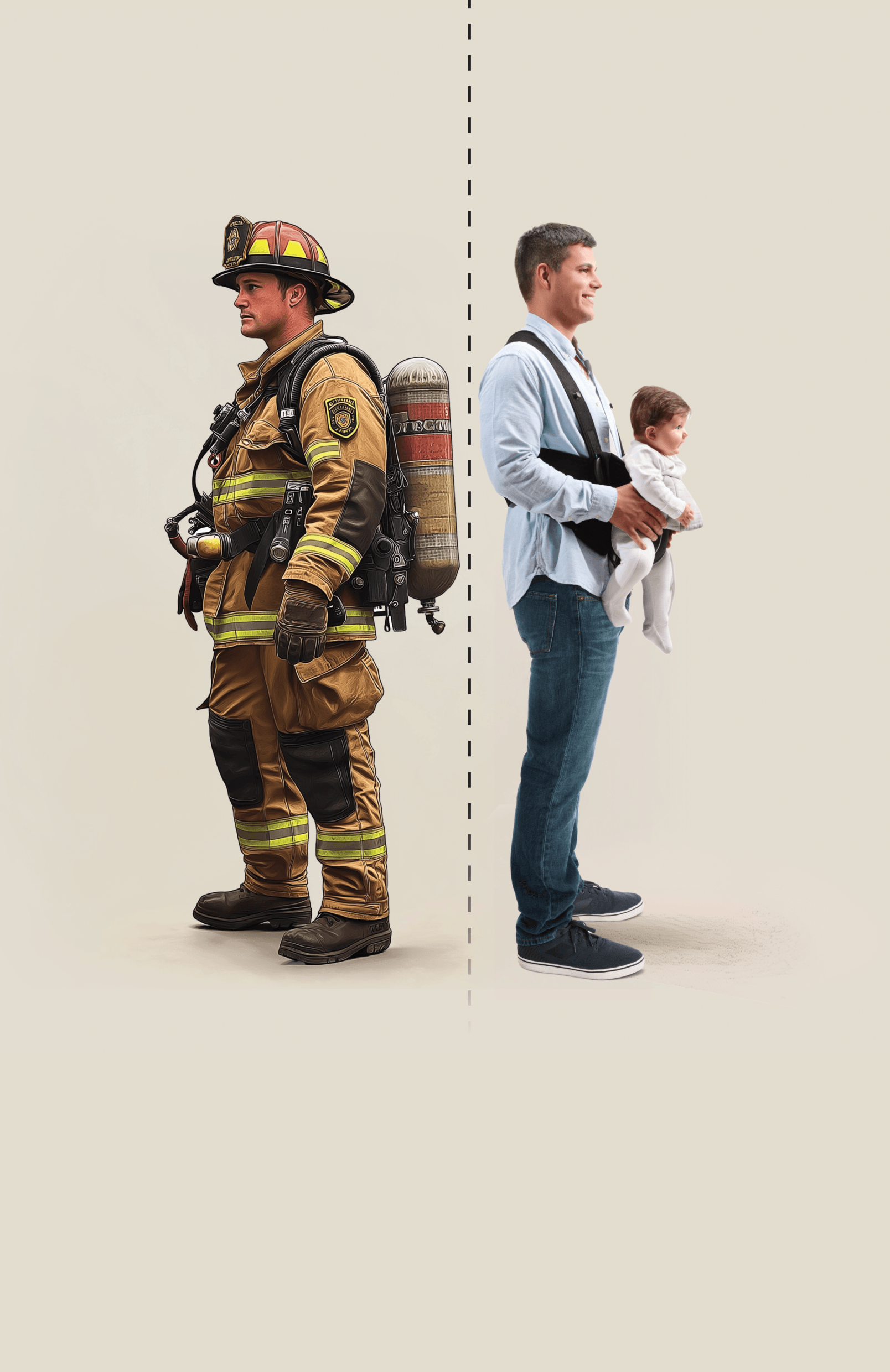

Inspired by insights from PSPNET on the challenges of first responder households
There’s no manual for how to run a household built around shift work, adrenaline, and unpredictability. Firefighters live by systems — accountability, chain of command, and command presence — but at home, those systems can collapse into chaos. The schedule changes, the tone drops, and the balance resets. Everyone scrambles to hold their ground.
At some point, though, you realize something important: you’re not the only one fighting fires.
Your spouse isn’t sitting on the sidelines. They’re running their own call, just in a different kind of fireground: one filled with late-night logistics, emotional triage, and the constant hum of uncertainty. You run toward emergencies; they live inside the ripple effect of them. Both of you respond to alarms, they’re just different kinds.
The Shift
The shift never really ends for a firefighter’s family. When you walk out the door, your partner picks up what you can’t — the parenting, the planning, and the emotional management. They carry the unknowns you can’t control.
It’s easy to think of it as two worlds: yours and theirs. But the truth is, there’s just one system, and it only runs when both sides are in sync. The moment one side stops seeing the other, resentment starts creeping in.
At work, you run tactical briefings and after-action reviews. At home, there’s often silence, or worse, assumption. The firefighter assumes the spouse “doesn’t understand.” The spouse assumes the firefighter “doesn’t care.” Both are wrong. Both are tired.
The Single-Parent Illusion
In many responder homes, both people may feel like single parents. Each is running solo in their own orbit, convinced they’re the one doing more, feeling less understood.
That realization — that you’re both fighting to keep the same household alive from different fronts — can be the shift that changes everything. It takes the competition out of the equation, and replaces the silent scorekeeping with forgiveness and gratitude.
You start to see the late-night bottle feedings, the school drop-offs, and the emotional resets as what your partner held together so you could keep doing what you do.
The goal isn’t to prove who sacrifices more. It’s to see that both sacrifices matter equally.
The Firehouse Lens at Home
Most firefighters give more structure, respect, and teamwork to their crew than they do to their family. The firehouse gets systems, discipline, and accountability. Home gets whatever’s left.
But what if home became another form of the firehouse? Not in the rigid sense, but in the shared-mission sense: a place where communication flows, everyone knows their role, and feedback isn’t a fight but part of the operation.
You wouldn’t end a call without checking in with your crew. Why end a day without checking in with your family?
Ask the same questions you’d ask after a tough shift:
- What went well today?
- What was hard?
- What do you need from me next time?
It sounds simple. It’s not. But it’s where teamwork starts again.
Rewriting the Narrative
The job can make you the hero, but home is where you become human. If the only place you lead is at work, the system fails. If the only person who gets your best energy wears a uniform, the mission’s incomplete.
Your spouse doesn’t need you to fix everything; they just need you to notice. To say, “I see you carrying it, too.” To mean it.
That single sentence disarms the tension that builds in every responder relationship. It’s awareness.
CRACKYL Takeaways
**1. Ditch the Scoreboard.******You’re both operating at capacity. Stop comparing and start appreciating.
**2. Run a Home Debrief.******After tough stretches, talk like teammates. Ask questions. Listen like it’s a call worth getting right.
**3. Trade the Apology for Acknowledgment.******Don’t just say, “Sorry I wasn’t there.” Add, “Thank you for holding it down.”
**4. Remember the Mission.******The real measure of success is how strong your home base is when the tones go off again, not how many calls you ran.
**5. See the System, Not the Sacrifice.******The job and the relationship both demand presence. When you start treating your home life like part of your operating system, it stops feeling like a competition and starts feeling like a command team.
Your firehouse runs on trust, communication, and accountability. Your home should, too.
You don’t need to pick who’s carrying more, you just need to remember you’re both carrying us.