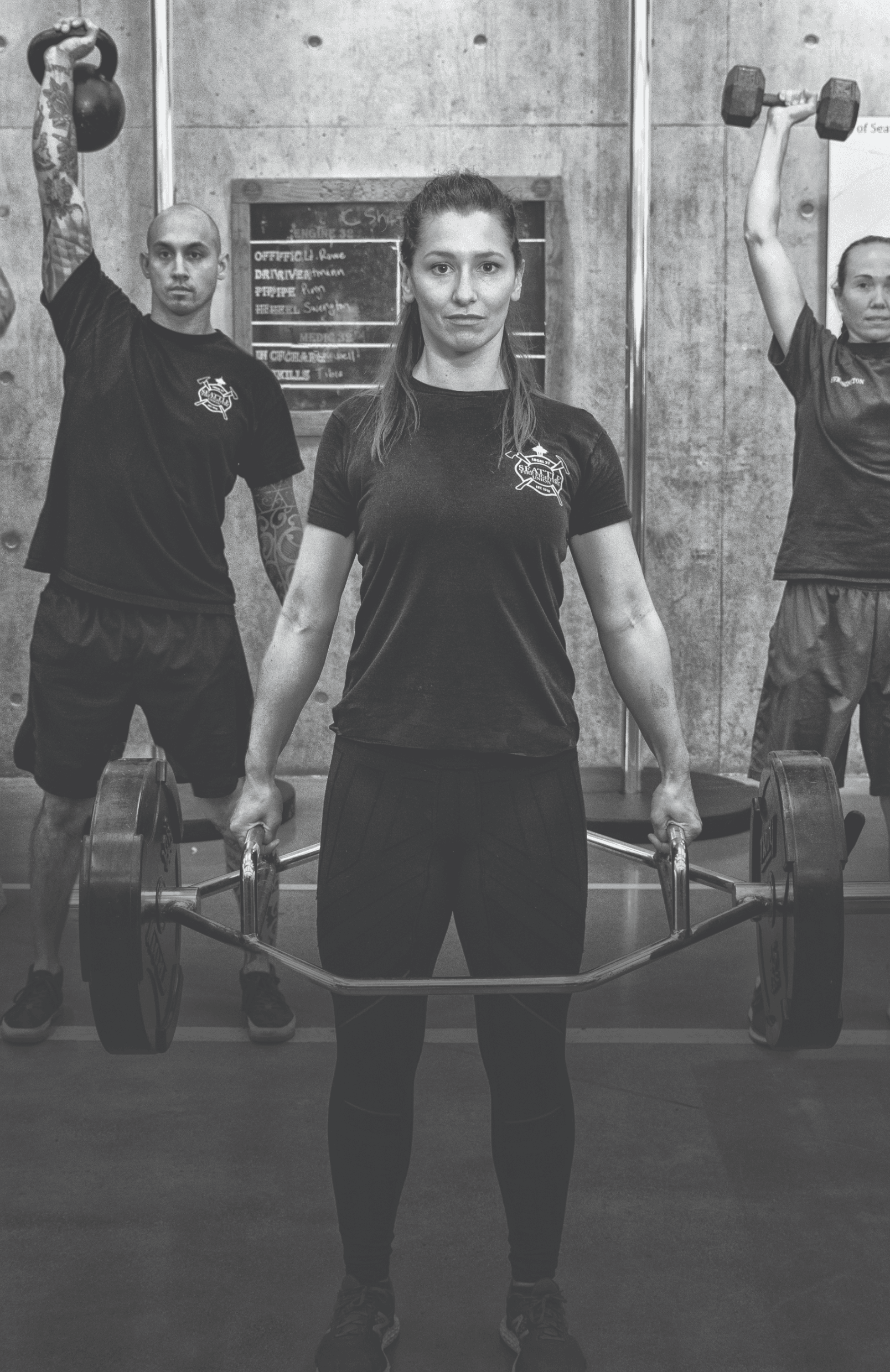

Firefighters love high intensity, grueling, circuit-style workouts. Slap 10-15 exercises up on the whiteboard, choose whether it’s going to be an AMRAP or an EMOM (etc.), make sure it’s as difficult as possible and get after it. Because after all, if you aren’t lying in a puddle of your own sweat did you even do anything?
We love (love/hate?) these types of workouts, too, but there’s a time and place for “gut-check” sessions. If you’re constantly red-lining, you may be leaving some “gains” at the table. You may also be taxing your central nervous system to the point of chronic fatigue or overtraining, leading to decreased performance and potentially increasing the risk of injury.
Compounded with the challenges firefighters inherently face with fatigue and sleep, overuse of this style of training may actually contribute to common recovery/injury issues experienced by the fire service. Alternatively, if your conditioning work only features low intensity steady-state sessions, you may also be leaving some important qualities behind. Having an “engine that can run for days” is great, but if there’s no strength or power to handle a spike in intensity, that can also be problematic.
Two questions we encourage firefighters to ask themselves are, “Am I just working out, or am I actually training?” or “How will this help make me better at my job?” This typically leads people to start considering details like volume, load, frequency, and goals. Ultimately, a well-rounded training program needs to have consistency to produce the desired result. If your workouts are always pieced together without a plan, you likely aren’t seeing the full benefits, and may even be unintentionally sabotaging all your hard work. As the old adage goes, “a failure to plan is a plan to fail.”
How to Level-Up Your Conditioning to Maximize Your Potential
First, it’s helpful to define conditioning and review some key aspects of the body’s energy systems.
So, what is conditioning? Simply put, it’s a firefighter’s ability to meet the energy production demands of their profession. And, as first responders, you really have to be prepared for anything and everything. From a strength and conditioning perspective, this boils down to having a bit of a “jack of all trades, master of none” approach.
The Energy Systems
It’s important to note that these three systems can be viewed independently, but they overlap. The differences are in the ability and amount of energy they contribute in response to demand.
The anaerobic alactic and lactic systems can rapidly and powerfully produce energy because they do not require oxygen. The downside is they can only produce for a short amount of time before fatiguing.
The aerobic system has a slower rate of energy production because it does rely on oxygen, but it can produce energy for long periods of time without fatigue.
Firefighting requires all three systems to various degrees, depending on the type of call for service. Very rarely will a call require the use of a single energy system; rather contribution from all three at various times in response to the energy requirement.
A robust aerobic system will allow you to sustain long periods of constant work and also feed your anaerobic systems’ ability to recover in between powerful efforts. Well-developed anerobic systems ensure you have power when needed.
The above diagram and examples below are inspired by Joel Jamieson’s Ultimate MMA Conditioning, a highly recommended resource for anyone interested in dialing in their conditioning. These concepts apply to a multitude of sports and tactical settings.
Anaerobic Alactic
- High intensity, short duration activity (think sprints)
- Quick bursts of power and speed
- 0-10 seconds of max effort
Two ways to program alactic work:
In this example, it’s important to remember that each rep needs to be maximal effort. And, because each rep is max effort, the rest needs to be long enough to reproduce a similar power output for subsequent reps. The athlete will alternate between an air bike and kettlebell swings for 10 seconds of all-out effort, resting two minutes during the transition. A total of six reps will be completed followed by 5-10 minutes of active rest (mobility work, walking, stairs, etc.), then another round of six reps.
Even though we are focused on alactic capacity, we still want maximal effort for the recommended duration. Multi-joint, compound, powerful movement works best in these sessions. In the example, the athlete will complete :15 work/:30 rest on the three exercises for four rounds. After 5-10 minutes of active rest (mobility work, etc.), the athlete will complete another four rounds with the same or new exercises.
Anaerobic Lactic
- Continuous high intensity, medium duration activity
- Approximately 60 to 90 seconds
Two ways to program lactic work:
For lactic power sessions, we like to keep things as simple as possible and cardio equipment can be a great option. We are still working at maximal effort, now with longer duration and incomplete rest periods (not fully rested or HR below 130). In the example, the athlete will select the equipment of choice and complete :40 work/1:00 rest for three rounds. After a five-minute active rest, the athlete may select the same or different equipment and repeat the same intervals.
In the example, the athlete will complete as many reps as possible (max effort, with good form) in the kettlebell goblet squat and immediately move into the medicine ball overhead slam. After the slam, the athlete will move immediately into a split stance kettlebell row. Once :30 of work are completed at each exercise (1:30 total work) the athlete will rest 1-2 minutes before repeating three additional (four total) rounds. After the four rounds, the athlete will complete active rest followed by 2-3 more sets.
Aerobic
- Low to moderate intensity activities
- (up to) hours
Two ways to program aerobic work:
In this example, the athlete will use low speed-heavy resistance exercises to train the fast-twitch fibers’ use of oxygen. These would require some form of heart rate monitor. The athlete will complete a single repetition of the exercise, then rest until their heart rate drops to 140 bpm or lower. This will be repeated after each rep for the prescribed volume.
This method is perhaps the easiest to get creative and have fun. Pick some exercises you like that can be sustained for a moderate pace, and complete 30-90 minutes of continuous (no rest) work, keeping the heart rate between 130-150 (commonly referred to as Zone 2).
Once you understand the parameters for each system and goal, there are limitless possibilities for workout creativity. However, it’s important to follow the guidelines as recommended. Too often, tactical athletes are in a rush and don’t take adequate time to recover in order to maximize the effectiveness of each rep.
Ok, So How Do We Put This Into Practice?
One of the most simple ways to incorporate workouts targeting each system is to rotate through the three. Determine where in your week you want to focus on conditioning and pick one of the systems; then move to a different focus for your second session, and so on.
Here’s a few examples of how this could look across a two-week span of training if you work a 48/96:
Example of an upper/lower split with conditioning separate:
Example of a total body approach:
Example of an upper/lower split with conditioning mixed:
This is not an extensive list, and as already mentioned, there are plenty of possibilities. It’s important you figure out what works best for YOU. It’s also important to consider the other factors that may impact your training decisions, like the number of calls you ran the day/night before, sleep quality, soreness, fatigue, stress levels, etc. Having a plan is imperative, but having flexibility within that plan is also crucial for firefighters.
Training with intent and purpose will serve firefighters well; improving their ability to work for long periods of time and express power, and improving recovery during calls and between shifts. Utilize these methods and be certain you and your crew are ready to tackle the unknown.