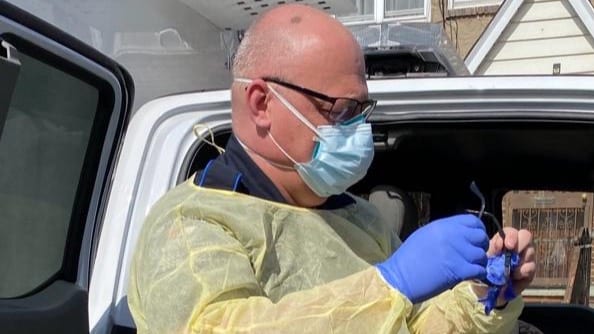
Paul Partain dons personal protective equipment prior to working a cardiac arrest during the height of the pandemic.
The recent film Code 3, starring Rainn Wilson as a paramedic grappling with PTSD and burnout, has struck a chord with many in EMS. While presented through a comedic lens, the movie accurately portrays a reality that countless paramedics and EMTs face daily: the psychological toll of repeatedly witnessing humanity’s worst moments.
We’re trained to stay calm under pressure and in some of the most chaotic situations imaginable. We compartmentalize, then move quickly from one call to the next. Somewhere along the way, many of us adopt dark humor as our shield and convince ourselves we’re unaffected by what we see. “It doesn’t bother me anymore,” we say, as if emotional invulnerability were a badge of honor rather than a warning sign. This very coping mechanism often contributes to burnout in ways we don’t recognize or understand until one day we find ourselves dreading coming to work in a job we used to love.
Every paramedic or EMT has at least one call that “got to them.” Pediatric cases are frequently cited as particularly devastating. The sick child, the traumatic injury, the death that feels fundamentally wrong because of its suddenness, or the immediate toll it takes on loved ones. These calls bypass our carefully constructed defenses.
The Aftermath of a Traumatic Call
One of the most poignant moments in Code 3 comes when Randy reflects on a traumatic call: “Someone’s gotta have that image in their brain for the rest of their lives. I’m that somebody.” It’s a simple statement that captures the essence of what we do.
For me, the stressor that still stays with me came as I was working on a 911 ambulance in the Elmhurst neighborhood of Queens, N.Y. – the “epicenter of the epicenter” during the height of the pandemic. Cardiac arrests became so routine they blurred together. But what I still carry years later isn’t the cardiac arrests. For me, it was the critical COVID patients we were picking up from their homes. Treating or transporting them wasn’t particularly problematic, managing sick patients is what we do. Instead, it was standing at the ambulance doors, telling frightened family members they couldn’t come along. I learned to phrase it carefully: “We’ll give you a few moments to say goodbye,” trying to imply a finality that would let them have potentially one last meaningful exchange. Most of those patients weren’t going to survive and we knew it. The weight of facilitating those goodbyes, of being the barrier between desperate loved ones and dying family members, accumulated in ways I didn’t recognize until much later.
The stark contrast of Roosevelt Avenue, Corona, Queens, during COVID-19: Normally a vibrant thoroughfare teeming with pedestrians and street vendors (bottom),
sits eerily deserted at the height of the pandemic (top).
During those darkest days, my close friend, FDNY Deputy Assistant Chief Frank Leeb, became an important lifeline. He would call me periodically just to check in, to see how I was holding up under the immense stress. I remember one call in particular, he reached out literally as he was walking into a meeting with city leadership, dealing with his own overwhelming responsibilities, yet he took the time to reach out. That connection, that reminder that someone outside the immediate chaos cared enough to check on me, became a vital anchor. It was a check against the non-stop horror I was seeing every day, a reminder there was still a world beyond the ambulance and the dying patients and the grieving families.
This is burnout: not a single catastrophic event, but the gradual erosion of our emotional resilience under the constant drip of trauma, illness, and compassion fatigue. It’s the accumulation of trauma we tell ourselves doesn’t hurt.
Every EMS agency should offer some form of Critical Incident Stress Management (CISM), and I cannot emphasize enough the importance of actually using these resources. There’s no weakness in seeking help; the weakness is in allowing pride to destroy your mental health and, potentially, your career. CISM teams understand the unique challenges we face and can provide both immediate support after critical incidents and longer-term resources for managing cumulative stress.
Beyond CISM, here are essential strategies for managing stress and preventing burnout:
Establish Firm Work-Life Boundaries
The job will always demand more than you can give. An ongoing issue for many in this profession is financial pressure, due to inadequate compensation that makes picking up extra shifts feel necessary rather than optional. However, there comes a point where the physical and psychological cost outweighs the financial benefit. Learn to recognize when you’re already exhausted and avoid picking up extra shifts. If financial necessity is driving you to work unsustainable hours, consider advocating for better wages within your organization or exploring agencies with better compensation. Your long-term health and career viability depend on finding a sustainable balance.
Develop and Maintain Connections Outside of EMS
My experience with Frank taught me something crucial: you need people in your life who care about you, not just about what you can do for them on the next call. While your colleagues understand the job in ways others can’t, you need relationships that aren’t centered on trauma. Maintain friendships and family connections. Pursue hobbies that have nothing to do with the job.
Prioritize Physical Health
Exercise, adequate sleep, and proper nutrition aren’t luxuries, they’re foundations for psychological resilience. Stress response is physiological. Regular physical activity can reduce anxiety and depression. This is an area I’m currently focusing on. It’s easy to let physical health slide when you’re exhausted from shift work and irregular schedules. Even small steps such as a short walk, choosing healthier meals when possible, and protecting your sleep schedule can make a significant difference in your ability to cope with the daily stresses of EMS work.
Practice Regular Mental Health Check-ins
Whether through professional therapy, peer support, or structured debriefings, create space to process what you’ve experienced. Waiting until you’re in crisis makes recovery much harder. Consider therapy not as an emergency intervention but as preventive maintenance for your mental health.
Recognize Warning Signs Early
Increased cynicism, emotional numbness, difficulty sleeping, relationship problems, or reliance on alcohol or substances to cope are all red flags that shouldn’t be ignored. If your family or friends express concern about changes they’re seeing in you, listen to them. They often notice what we’re too close to see.
Take Your Time Off Seriously
Use your vacation days. Truly disconnect when you’re off duty. Turn off the phone, skip the work group chats, and permit yourself to not be available. You cannot pour from an empty cup.
Remember Your “Why”
Reconnect with what drew you to EMS. Sometimes remembering the meaning behind the work can help sustain you through difficult periods. But also permit yourself to acknowledge when the cost is becoming too high.
The culture of EMS is slowly changing. We’re beginning to recognize that acknowledging our trauma doesn’t make us weak, it makes us human. The calls that “get to us” aren’t failures; they’re proof we haven’t lost our capacity for empathy, which is essential for compassionate care. We’re learning to have conversations about mental health without shame, and to support each other not just in the field but in recovery.
Code 3 may be a comedy, but it offers a valuable reminder: the bravest thing we can do isn’t pretending we’re unaffected by what we see. It’s admitting when we’re struggling and actively seeking the help we need to continue serving our communities without destroying ourselves in the process.
Paul Partain is a paramedic supervisor at Northwell Health Center for Emergency Medical Services, the largest hospital-based EMS agency in the New York Metropolitan Area. The views expressed in this article are the author’s own and are not the views of Northwell Health.